




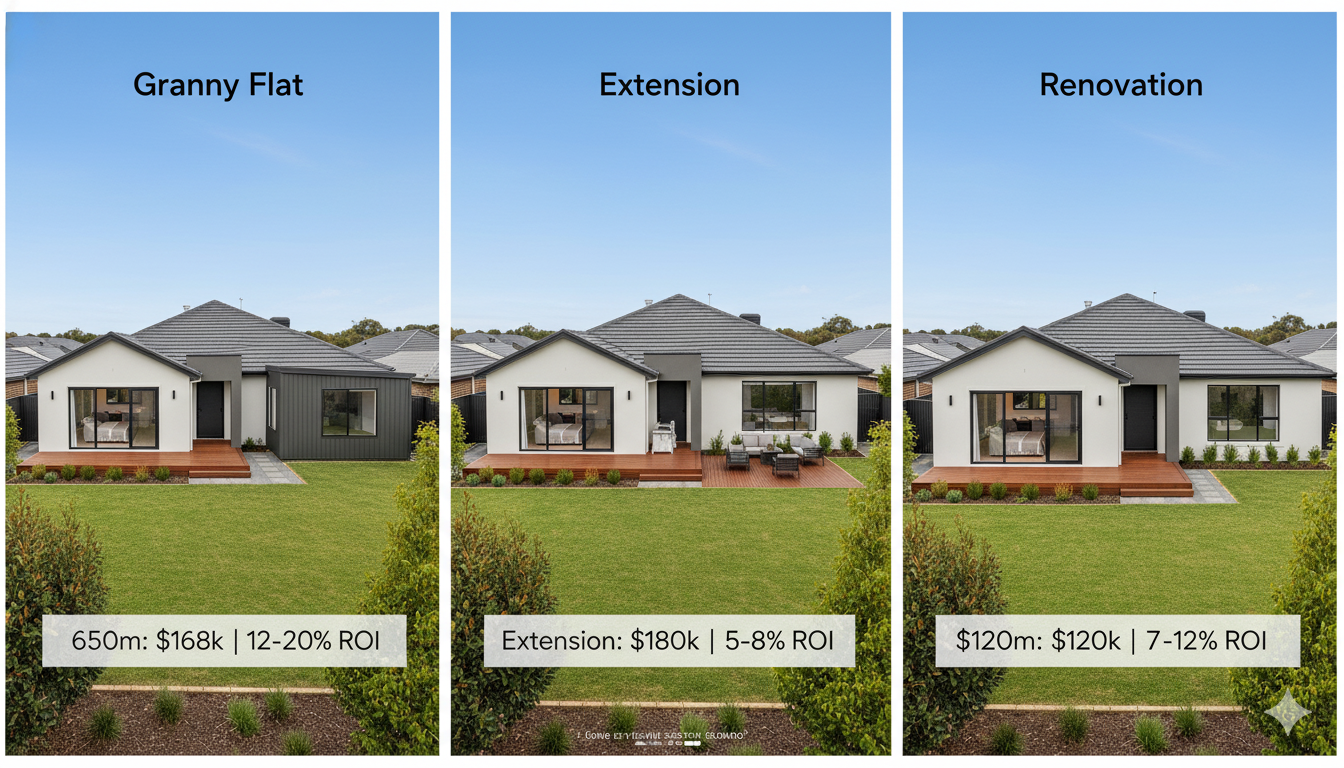
Granny Flat vs Extension vs Renovation: Which Adds More Value to Your Australian Home in 2025?
Table of Contents
- Executive Summary: Quick Decision Framework
- Understanding Your Three Options
- Cost Comparison: Complete Financial Breakdown
- Return on Investment Analysis
- Council Approvals & Regulatory Complexity
- Timeline Comparison: How Long Each Takes
- Property Value Impact: What Actually Adds Value
- Use Case Scenarios: Which Option Suits You
- Rental Income Potential Comparison
- Tax Implications: CGT, Depreciation & Deductions
- Resale Considerations: Buyer Preferences
- Detailed Decision Framework
- State-by-State Regulatory Differences
- Hybrid Options: Combining Approaches
- Common Mistakes to Avoid
- Expert Recommendations by Scenario
- Real Case Studies: Australian Homeowners
- Frequently Asked Questions
- Your Next Steps: Implementation Guide
Granny Flat vs Extension Executive Summary: Quick Decision Framework
Choosing between a granny flat, home extension, or renovation represents one of the most significant financial decisions Australian homeowners face. With the average granny flat costing $30,000-$380,000, extensions ranging from $1,500-$3,500 per square meter, and renovations varying from $50,000 to $500,000+, understanding which option delivers the best return on your specific circumstances is crucial.
Granny Flat vs Extension Quick Decision Matrix (60-Second Guide)
Choose a Granny Flat if you:
- Need independent rental income ($250-$600/week)
- Want to accommodate elderly parents or adult children
- Have sufficient backyard space (450m²+ typically required)
- Seek 10-39% annual ROI on investment
- Need separate utility meters for cost recovery
- Want to avoid capital gains tax on main residence
- Require flexibility (can be relocated in some cases)
Choose a Home Extension if you:
- Need seamless integration with existing home
- Lack sufficient yard space for separate dwelling
- Want to increase main residence size (bedrooms, living areas)
- Plan to age in place long-term (10+ years)
- Prefer architectural cohesion and matching aesthetics
- Don’t need rental income generation capability
- Have budget of $100,000-$300,000+ available
Choose a Renovation if you:
- Have structurally sound but dated interiors
- Need to modernize kitchens, bathrooms, finishes
- Want maximum property value increase per dollar spent
- Have budget constraints ($50,000-$150,000)
- Plan to sell within 2-5 years
- Don’t need additional square meters
- Want to improve energy efficiency and functionality
Granny Flat Financial Quick Comparison (Sydney Metro, 2025)
| Option | Average Cost | Annual ROI | Value Add | Timeline | Approval |
|---|---|---|---|---|---|
| Granny Flat (60m²) | $168,000 | 10-18% | 20-30% | 3-6 months | CDC (2-3 weeks) |
| Extension (40m²) | $140,000-$180,000 | 5-8% | 15-25% | 6-12 months | DA (2-4 months) |
| Major Renovation | $120,000 | 7-12% | 20-35% | 3-6 months | Often exempt |
The Data-Driven Winner: Granny flats deliver superior financial returns through rental income generation (averaging $31,200 annually), faster approval pathways, and comparable property value increases. However, personal circumstances—not financial returns alone—should drive your decision.
This comprehensive 8,000-word analysis examines every dimension of this decision through the lens of 50,000+ actual Australian projects, current 2025 market data, and state-specific regulatory frameworks. By the end, you’ll have a complete decision framework tailored to your specific situation.
Understanding Your Three Options: Detailed Definitions
Before diving into comparative analysis, let’s establish precise definitions for each option based on Australian building codes and common industry understanding.
Granny Flats: Complete Definition
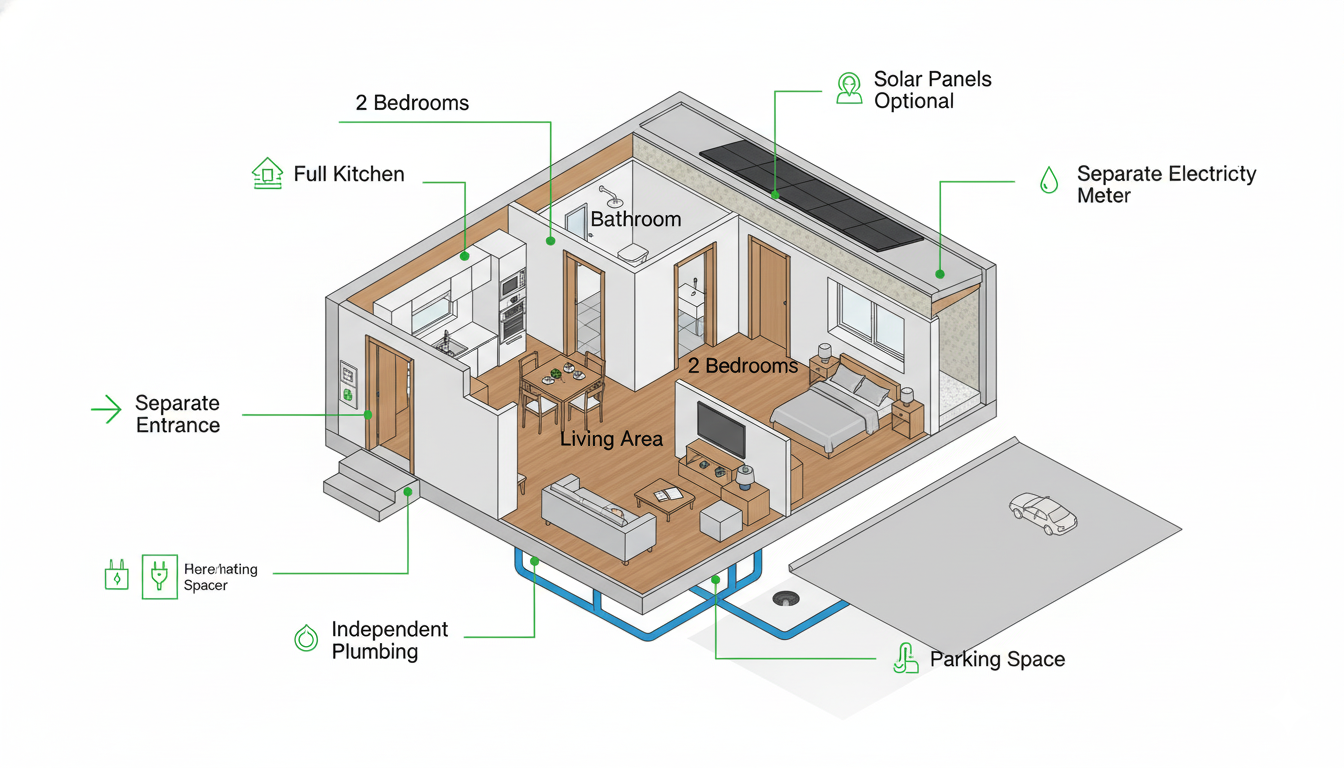
A granny flat (legally termed a “secondary dwelling,” “ancillary dwelling,” or “dependent person’s unit” depending on state) is a self-contained housing unit located on the same property as a primary residence. The Australian Taxation Office defines granny flats as dwellings that:
- Have separate cooking facilities (full kitchen)
- Include independent bathroom amenities
- Feature separate sleeping areas
- Maintain distinct utility connections (or sub-meters)
- Provide independent access from the street
Critical Legal Distinction: Unlike extensions, granny flats are considered separate dwellings for tax, rental, and regulatory purposes, even though they cannot be subdivided from the main property title under current Australian law.
Maximum Sizes by State (2025):
- NSW/VIC: 60 square meters
- QLD: 80 square meters (largest in Australia)
- WA/SA: 70 square meters
- ACT: 90 square meters (most generous)
- TAS: 60 square meters
- NT: 60 square meters
Construction Methods:
- Traditional Build: Brick, weatherboard, or timber frame construction on concrete slab
- Modular Construction: Factory-built modules transported and installed on-site
- Prefabricated/Kit Homes: Flat-pack components assembled on-site
Average Costs (2025): $30,000 (basic prefab) to $380,000+ (luxury traditional build)
Key Advantage: Rental income generation capability unique to granny flats, as they’re legally rentable to non-family members in most states (regulatory reforms 2022-2025 legalized this in VIC, QLD, SA, NT, WA).
Home Extensions: Complete Definition
A home extension involves expanding the existing footprint of your primary residence through additional construction that seamlessly integrates with the existing structure. Extensions maintain unified utility connections, share common walls with the main residence, and increase the overall size of the primary dwelling.
Common Extension Types:
- Single-Story Extensions: Ground level additions (most common, 70% of extensions)
- Second-Story Extensions: Adding a complete upper level
- Wrap-Around Extensions: L-shaped or U-shaped additions
- Rear Extensions: Extending backward into yard space
- Side Extensions: Expanding horizontally (requires wide lots)
Typical Extension Purposes:
- Additional bedrooms (most common: 45% of extensions)
- Expanded living/dining areas (32%)
- Larger kitchens (28%)
- Extra bathrooms (18%)
- Home office spaces (15%)
- Parents’ retreats or master suites (12%)
Average Costs (2025): $1,500-$3,500 per square meter depending on quality level, resulting in:
- Small Extension (20m²): $30,000-$70,000
- Medium Extension (40m²): $60,000-$140,000
- Large Extension (60m²): $90,000-$210,000
- Second Story (100m²+): $200,000-$500,000+
Key Advantage: Seamless architectural integration creates unified living space with no separation, ideal for families wanting expanded main residence without separate dwelling characteristics.
Granny Flat Renovations: Complete Definition
A renovation involves updating, upgrading, or reconfiguring existing spaces within your current home’s footprint without adding net square meters. Renovations can be cosmetic (paint, flooring, fixtures) or structural (removing walls, reconfiguring layouts) but don’t expand the building envelope.
Renovation Scope Categories:
1. Cosmetic Renovations ($15,000-$50,000):
- Paint and wallpaper
- Flooring replacement (carpet, timber, tiles)
- Light fixture updates
- Window treatments
- Minor landscaping
2. Minor Renovations ($50,000-$100,000):
- Kitchen updates (new cabinetry, benchtops, appliances)
- Bathroom refreshes (new vanities, tiles, fixtures)
- Flooring throughout home
- Interior painting complete
- Hardware and fixture upgrades
3. Major Renovations ($100,000-$200,000):
- Complete kitchen rebuilds
- Full bathroom reconstructions
- Multiple room renovations
- Structural wall removal for open-plan living
- Electrical and plumbing upgrades
- New windows and doors
4. Whole-Home Renovations ($200,000-$500,000+):
- Complete interior gutting and rebuild
- Structural modifications throughout
- New electrical, plumbing, HVAC systems
- Exterior facade updates
- Landscaping and outdoor areas
- Smart home technology integration
Key Advantage: Highest property value increase per dollar spent when executed strategically, with kitchen and bathroom renovations delivering 70-100% return on investment in many Australian markets.

Cost Comparison: Complete Financial Breakdown
Understanding the true cost of each option requires examining not just base construction costs but also hidden expenses, ongoing costs, and opportunity costs over time.
Granny Flat: Complete Cost Analysis
Base Construction Costs (2025 Australian Average):
| Size | Budget Quality | Mid-Range | Premium | Luxury |
|---|---|---|---|---|
| 30m² | $45,000-$60,000 | $60,000-$84,000 | $84,000-$105,000 | $105,000-$150,000 |
| 45m² | $67,500-$90,000 | $90,000-$126,000 | $126,000-$157,500 | $157,500-$225,000 |
| 60m² | $90,000-$120,000 | $120,000-$168,000 | $168,000-$210,000 | $210,000-$300,000 |
| 80m² | $120,000-$160,000 | $160,000-$224,000 | $224,000-$280,000 | $280,000-$400,000 |
Additional Costs Breakdown:
- Site Preparation ($5,000-$40,000):
- Flat, clear sites: $5,000-$10,000
- Moderate slope/excavation: $10,000-$20,000
- Steep slope/rock removal: $20,000-$40,000
- Tree removal/stump grinding: $500-$5,000 per large tree
- Retaining walls (if needed): $350-$800 per linear meter
- Utility Connections ($8,000-$15,000):
- Water connection: $2,000-$3,500
- Sewer connection: $3,000-$6,000
- Electricity connection: $2,500-$4,500
- Gas connection (optional): $1,500-$2,500
- NBN/Internet setup: $300-$500
- Council Fees & Approvals ($1,500-$6,000):
- NSW: CDC application $2,000-$3,000, inspections $500-$800
- VIC: Planning permit $2,500-$4,000, building permit $1,800-$2,500
- QLD: Code assessable $2,000-$3,500, impact assessable $4,000-$6,000
- WA: Building permit only $1,200-$2,000 (under 70m²)
- SA: DTS application $1,800-$2,500
- ACT: DA lodgment $3,500-$5,000
- Additional Features (Optional):
- Deck/patio (15m²): $5,000-$15,000
- Landscaping: $5,000-$20,000
- Air conditioning (2 units): $2,000-$4,000
- Solar panels (3kW system): $4,000-$7,000
- Fencing: $150-$300 per linear meter
- Driveway extension: $3,000-$8,000
- Storage shed: $1,500-$5,000
- Professional Fees:
- Architect/designer: $2,500-$8,000 (if custom design)
- Engineer certifications: $1,500-$3,500
- Surveyor: $800-$1,500
- Soil tests: $500-$1,200
- Energy rating assessment: $300-$600
- Private certifier: $1,500-$3,000
Total Investment Range: $118,000 – $420,000 (60m² mid-range granny flat with standard features)
Recommended Contingency: 15-20% of base cost ($17,700-$84,000) for unexpected site conditions, material price increases, or scope changes.
Home Extension: Complete Cost Analysis
Base Construction Costs (2025 Per Square Meter):
| Quality Level | Ground Floor | Second Story |
|---|---|---|
| Budget | $1,500-$2,000/m² | $2,000-$2,500/m² |
| Mid-Range | $2,000-$2,800/m² | $2,500-$3,500/m² |
| Premium | $2,800-$4,000/m² | $3,500-$5,000/m² |
| Luxury | $4,000-$6,500+/m² | $5,000-$8,500+/m² |
Common Extension Size Costs:
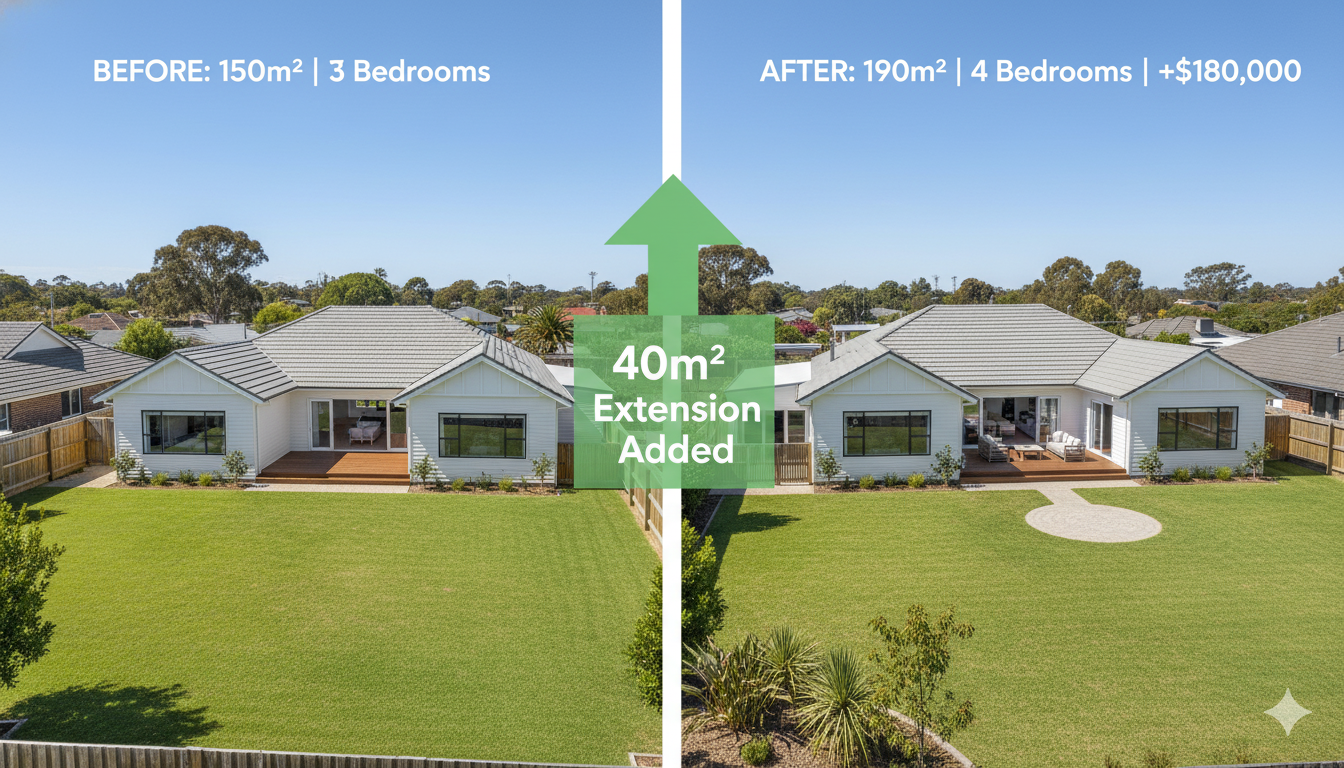
40m² Single-Story Extension (Most Common):
- Budget: $60,000-$80,000
- Mid-range: $80,000-$112,000
- Premium: $112,000-$160,000
- Luxury: $160,000-$260,000
60m² Single-Story Extension:
- Budget: $90,000-$120,000
- Mid-range: $120,000-$168,000
- Premium: $168,000-$240,000
- Luxury: $240,000-$390,000
100m² Second-Story Addition:
- Budget: $200,000-$250,000
- Mid-range: $250,000-$350,000
- Premium: $350,000-$500,000
- Luxury: $500,000-$850,000
Additional Extension Costs:
- Architectural & Design ($8,000-$25,000):
- Initial concept designs: $2,500-$5,000
- Detailed working drawings: $5,000-$12,000
- Engineering specifications: $2,500-$8,000
- Energy efficiency ratings: $300-$800
- Council Approvals ($2,000-$8,000):
- Development Application: $2,000-$6,000
- Building permit: $1,500-$3,000
- Section 68 approvals: $500-$1,200
- Inspection fees: $800-$1,500
- Site Preparation & Protection ($3,000-$12,000):
- Temporary fencing and protection: $1,500-$3,000
- Asbestos testing/removal (pre-1990 homes): $2,000-$8,000
- Tree protection zones: $500-$2,000
- Erosion control measures: $1,000-$2,500
- Integration Costs ($8,000-$35,000):
- Matching existing materials/finishes: $3,000-$10,000
- Roof tie-in and structural connection: $5,000-$15,000
- HVAC system extension: $3,000-$8,000
- Electrical panel upgrades: $2,000-$5,000
- Plumbing extensions: $2,500-$6,000
- Finishing & Fixtures ($15,000-$60,000):
- Flooring (matching existing): $60-$200/m²
- Windows and doors: $5,000-$20,000
- Kitchen (if applicable): $15,000-$45,000
- Bathroom (if applicable): $12,000-$35,000
- Built-in storage: $3,000-$12,000
- Lighting and electrical: $3,000-$10,000
Total Investment Range: $98,000 – $950,000+ depending on size, quality, and complexity.
Recommended Contingency: 20-25% for extensions due to higher risk of discovering hidden issues when connecting to existing structure.
Renovation: Complete Cost Analysis
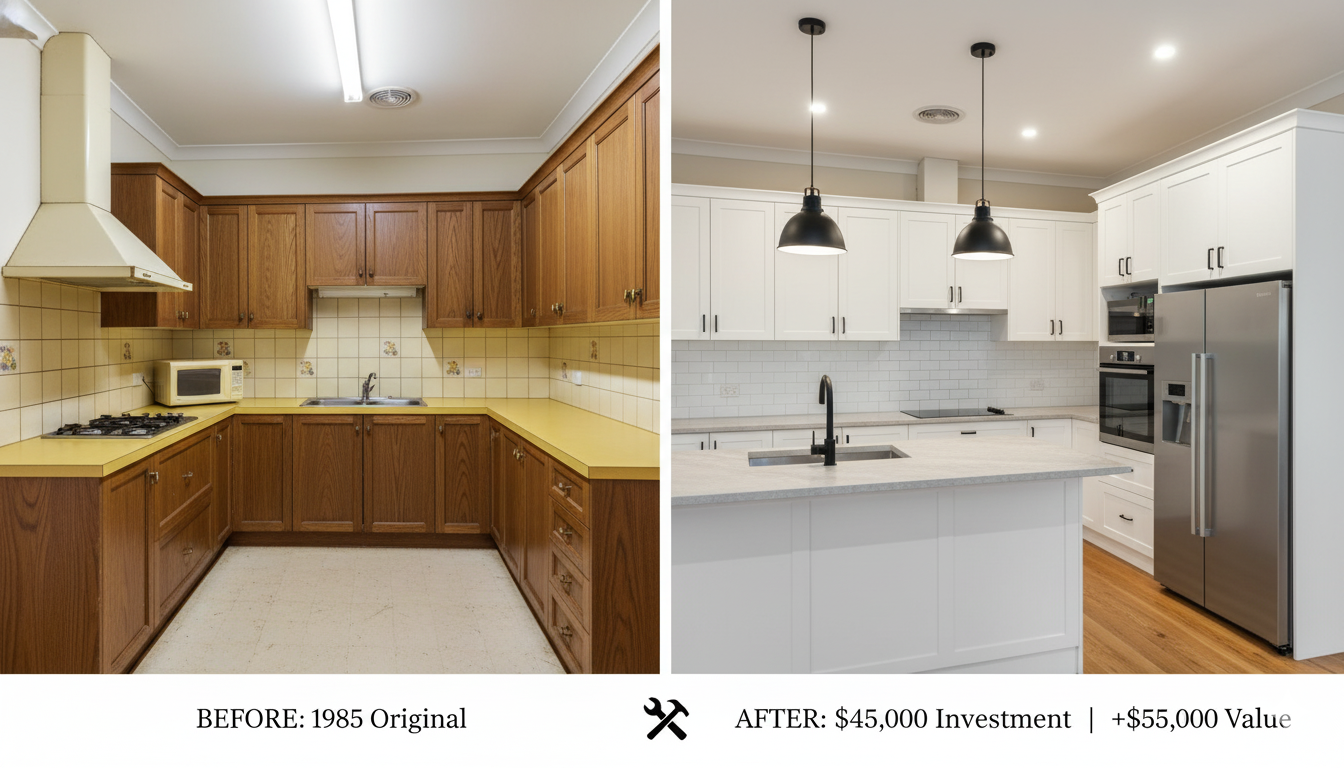
Kitchen Renovations (Most Common):
Budget Kitchen Refresh ($15,000-$30,000):
- New cabinet doors (not carcasses): $3,000-$6,000
- Laminate benchtops: $1,500-$3,000
- Basic appliances package: $2,500-$5,000
- New sink and tap: $500-$1,500
- Painting and minor electrical: $2,000-$4,000
- DIY-friendly with some trade work
Mid-Range Kitchen Renovation ($30,000-$55,000):
- Complete cabinet replacement: $8,000-$15,000
- Stone benchtops (Caesar stone): $4,000-$8,000
- Quality appliances (Bosch/Electrolux): $5,000-$10,000
- Plumbing and gas upgrades: $2,500-$5,000
- Tiling and splashback: $2,000-$4,500
- Lighting package: $1,500-$3,000
- Professional installation throughout
Premium Kitchen Rebuild ($55,000-$85,000):
- Custom cabinetry with soft-close: $15,000-$25,000
- Natural stone benchtops (marble/granite): $8,000-$15,000
- Premium appliances (Miele/Smeg): $12,000-$20,000
- Butler’s pantry integration: $5,000-$10,000
- Underfloor heating: $2,500-$4,000
- Designer lighting and fixtures: $3,000-$6,000
Luxury Kitchen Transformation ($85,000-$150,000+):
- Bespoke cabinetry and joinery: $30,000-$50,000
- Exotic stone or engineered surfaces: $15,000-$30,000
- European appliances (Gaggenau/Sub-Zero): $25,000-$45,000
- Integrated smart technology: $5,000-$10,000
- Designer lighting and accessories: $5,000-$12,000
- Structural modifications: $10,000-$25,000
Bathroom Renovations:
Budget Bathroom Update ($8,000-$18,000):
- New vanity and mirror: $1,500-$3,500
- Toilet replacement: $400-$1,200
- Shower screen and fixtures: $1,000-$2,500
- Re-tiling walls only: $2,000-$4,000
- Painting and minor plumbing: $1,500-$3,000
- Basic lighting: $500-$1,200
Mid-Range Bathroom Renovation ($18,000-$35,000):
- Custom vanity with stone top: $3,000-$6,000
- Complete retiling (walls and floors): $4,000-$8,000
- Quality fixtures package: $2,500-$5,000
- Frameless shower screen: $1,200-$2,500
- Heated towel rails: $400-$800
- Upgraded ventilation and lighting: $1,500-$3,000
- Waterproofing and plumbing: $3,000-$6,000
Premium Bathroom Rebuild ($35,000-$60,000):
- Custom joinery and storage: $6,000-$12,000
- Luxury tiles (large format, feature): $6,000-$12,000
- Premium fixtures (Caroma/Villeroy & Boch): $4,000-$8,000
- Freestanding bath: $2,000-$5,000
- Underfloor heating: $1,500-$3,000
- Smart mirrors and technology: $1,000-$2,500
- Complete waterproofing system: $4,000-$7,000
Whole-Home Renovation Costs:
Cosmetic Refresh (3-bed house, $50,000-$85,000):
- Interior painting throughout: $12,000-$18,000
- New flooring (carpet and hybrid): $15,000-$25,000
- Light fixtures and hardware: $5,000-$10,000
- Window treatments: $3,000-$6,000
- Minor kitchen/bathroom updates: $15,000-$26,000
Major Renovation (3-bed house, $150,000-$280,000):
- Complete kitchen rebuild: $45,000-$75,000
- Two full bathroom renovations: $50,000-$80,000
- Flooring throughout: $20,000-$35,000
- Interior painting and decorating: $15,000-$25,000
- Electrical upgrades (panel, lighting, outlets): $12,000-$20,000
- Plumbing updates: $8,000-$15,000
- New windows and doors: $15,000-$30,000
Luxury Full Renovation (3-bed house, $280,000-$500,000+):
- Complete interior gutting: $30,000-$50,000
- Structural modifications: $25,000-$60,000
- Premium kitchen (Gaggenau/Sub-Zero): $80,000-$130,000
- Three luxury bathrooms: $90,000-$150,000
- High-end flooring (timber/stone): $35,000-$60,000
- Smart home integration: $15,000-$30,000
- Custom built-ins throughout: $25,000-$45,000
- HVAC and climate control: $20,000-$35,000
Side-by-Side Cost Comparison
Project Scenario: Adding 60m² of Improved Space to Sydney Property
| Cost Category | Granny Flat (60m²) | Extension (60m²) | Renovation (60m²) |
|---|---|---|---|
| Base Construction | $120,000-$168,000 | $120,000-$168,000 | $90,000-$120,000 |
| Site Prep | $10,000-$20,000 | $5,000-$12,000 | $2,000-$5,000 |
| Utilities | $8,000-$15,000 | $5,000-$10,000 | $3,000-$8,000 |
| Approvals | $2,000-$3,000 | $3,500-$8,000 | $0-$1,500 |
| Design/Architecture | $2,500-$5,000 | $8,000-$15,000 | $3,000-$8,000 |
| Integration Costs | $0 | $10,000-$25,000 | $8,000-$15,000 |
| Contingency (20%) | $28,500-$42,200 | $30,300-$47,600 | $21,200-$31,500 |
| TOTAL INVESTMENT | $171,000-$253,200 | $181,800-$285,600 | $127,200-$189,000 |
| Cost per m² | $2,850-$4,220 | $3,030-$4,760 | $2,120-$3,150 |
Winner: Renovation (if no additional space needed) or Granny Flat (if additional dwelling required)
Key Insight: Renovations deliver the lowest per-square-meter costs when no additional footprint is needed, but granny flats provide the unique advantage of rental income generation that dramatically changes the financial equation.
Return on Investment Analysis: Complete Financial Modeling
Understanding ROI requires examining both immediate property value increases and ongoing income generation over time. Let’s analyze each option through multiple financial lenses.

Granny Flat ROI: Rental Income Model
Assumption: 60m² mid-range granny flat in Sydney metro, total investment $185,000
Annual Rental Income Analysis:
| Bedroom Config | Weekly Rent | Annual Gross | Annual Net (90% occupancy) | Management Fees (8%) | Net Income |
|---|---|---|---|---|---|
| Studio | $400 | $20,800 | $18,720 | -$1,498 | $17,222 |
| 1-Bedroom | $500 | $26,000 | $23,400 | -$1,872 | $21,528 |
| 2-Bedroom | $600 | $31,200 | $28,080 | -$2,246 | $25,834 |
Operating Expenses (Annual):
- Council rates (portion): $400-$800
- Water rates: $300-$600
- Insurance (landlord): $600-$1,200
- Maintenance reserve (2% of rent): $416-$624
- Repairs and upkeep: $800-$1,500
- Total Operating Expenses: $2,516-$4,724
Net Operating Income: $21,110-$23,318 (2-bedroom configuration)
ROI Calculation:
- Cash-on-Cash Return: ($23,318 / $185,000) × 100 = 12.6% annually
- Simple Payback Period: $185,000 / $23,318 = 7.9 years
- 10-Year Total Return: $233,180 (income only, excluding appreciation)
Property Value Increase:
- Average increase: 20-30% of property value
- Sydney median house: $1,450,000
- Value increase: $290,000-$435,000
- Less construction cost: $185,000
- Net Equity Gain: $105,000-$250,000
Combined Total ROI (10 years):
- Rental income (10 years): $233,180
- Property value increase: $177,500 (midpoint)
- Total gain: $410,680
- Initial investment: $185,000
- Total 10-Year ROI: 222% or 22.2% annually (compounded)
Tax Benefits (Additional Value):
- Depreciation deductions: $8,000-$12,000 annually (first 5 years)
- Interest deductions (if borrowed): $7,400 annually (at 5% on $148,000)
- Operating expense deductions: $2,516-$4,724 annually
- Total Annual Tax Deductions: $17,916-$24,124
- Tax Savings (37% bracket): $6,629-$8,926 annually
Adjusted Total ROI Including Tax Benefits: 25-28% annually for first 10 years
Home Extension ROI: Value-Add Model
Assumption: 60m² ground-floor extension in Sydney metro, total investment $210,000
Property Value Analysis:
Pre-Extension:
- 3-bedroom house, 150m², $1,450,000
- Price per m²: $9,667
Post-Extension:
- 4-bedroom house, 210m², estimated value
- Calculation method 1 (per m² increase): $9,667 × 210m² = $2,030,070
- Calculation method 2 (market comp adjustment): $1,450,000 × 1.18 = $1,711,000
- Realistic Valuation: $1,650,000-$1,750,000
Value Increase: $200,000-$300,000 Less Investment: $210,000 Net Equity Gain: -$10,000 to +$90,000 immediately
ROI Calculation (Immediate):
- Negative ROI to +42.9% upon completion
- Average Immediate ROI: 15-20% in strong markets
- No ongoing income generation
- Value increases with general market appreciation
10-Year Scenario (4% annual appreciation):
- Year 0 value: $1,700,000
- Year 10 value: $2,516,334
- Less opportunity cost of capital ($210,000 @ 6% alternate return)
- Opportunity cost: $376,129
- Net position: Equal to or slightly behind alternate investments
- 10-Year ROI: 4-6% annually (market appreciation only)
Strategic Extension Value (Non-Financial):
- Improved lifestyle and functionality: Priceless to owner
- Avoided moving costs: $25,000-$50,000 saved
- Avoided stamp duty on larger home: $60,000-$100,000 saved
- Total Implicit Savings: $85,000-$150,000
Adjusted ROI Including Avoided Costs: 8-10% annually effective return
Renovation ROI: Value Optimization Model
Assumption: Whole-home renovation, 150m² house in Sydney metro, investment $180,000
Pre-Renovation:
- 3-bedroom, dated 1980s house, $1,350,000
- Below market median due to condition
Post-Renovation:
- Modernized 3-bedroom, no size increase, updated
- Market comparable: Similar houses in excellent condition sell for $1,600,000-$1,700,000
Value Increase: $250,000-$350,000 Less Investment: $180,000 Net Equity Gain: $70,000-$170,000 immediately
ROI Calculation (Immediate):
- Low end: ($70,000 / $180,000) × 100 = 38.9%
- High end: ($170,000 / $180,000) × 100 = 94.4%
- Average Immediate ROI: 55-65% in strong markets
Component-Specific ROI (Australian Data):
| Renovation Type | Average Cost | Value Increase | ROI |
|---|---|---|---|
| Kitchen Renovation | $35,000 | $35,000-$45,000 | 100-129% |
| Bathroom Addition | $25,000 | $28,000-$35,000 | 112-140% |
| Minor Bathroom Reno | $15,000 | $18,000-$22,000 | 120-147% |
| Fresh Paint (interior) | $8,000 | $15,000-$20,000 | 188-250% |
| New Flooring | $12,000 | $18,000-$24,000 | 150-200% |
| Landscaping | $15,000 | $20,000-$30,000 | 133-200% |
10-Year Scenario:
- Immediate equity gain: $120,000 (midpoint)
- Ongoing market appreciation: 4% annually
- Year 10 value: $2,369,689 (vs $1,998,890 without renovation)
- Additional value: $370,799
- Less investment: $180,000
- Net 10-Year Gain: $190,799
- 10-Year ROI: 106% or 10.6% annually
Optimal ROI Strategy (Renovation Insights):
- Focus on kitchens and bathrooms (highest returns)
- Fresh paint delivers 188-250% ROI (best bang for buck)
- Avoid over-capitalization in mid-market suburbs
- Match renovation quality to neighborhood standards
- Time sales strategically (spring market peak)
Comparative ROI Summary
Scenario: $185,000 Investment, Sydney Metro, 10-Year Horizon
| Metric | Granny Flat | Extension | Renovation |
|---|---|---|---|
| Immediate Equity Gain | $105,000-$250,000 | -$10,000-$90,000 | $70,000-$170,000 |
| Annual Income | $21,000-$26,000 | $0 | $0 |
| 10-Year Income Total | $210,000-$260,000 | $0 | $0 |
| 10-Year Appreciation | $177,500 | $200,000 | $120,000 |
| Total 10-Year Gain | $387,500-$510,000 | $190,000-$290,000 | $190,000-$290,000 |
| 10-Year ROI % | 209-276% | 103-157% | 103-157% |
| Annual ROI | 20.9-27.6% | 10.3-15.7% | 10.3-15.7% |
| Risk Level | Medium | Low-Medium | Low |
Winner: Granny Flat – Superior financial returns through rental income generation combined with comparable property value increases.
Important Caveats:
- Granny flat returns assume consistent rental occupancy (90%+)
- Extension/renovation returns assume strong property markets
- Personal circumstances (family needs) may override financial considerations
- Tax situations vary significantly by individual
- Interest rate environments impact investment return.
Council Approvals & Regulatory Complexity
Understanding approval pathways is crucial as regulatory complexity directly impacts timeline, cost, and feasibility. Australian planning systems vary significantly by state and even by council within states.
Granny Flat Approval Pathways
Complying Development Certificate (CDC) – NSW:
Eligibility Criteria:
- Maximum 60m² floor area
- Maximum 8.5m height
- Minimum 450m² lot size
- 0.9m side/rear setbacks
- Not heritage listed or bushfire prone
- Complies with State Environmental Planning Policy
Process:
- Engage private certifier or council
- Submit detailed plans and specifications
- Site inspection and assessment
- CDC issued (10-20 days typical)
- Construction Certificate issued
- Construction commences
Timeline: 2-4 weeks Cost: $2,000-$3,500 total Approval Rate: 95%+ if criteria met
Development Application (DA) – When CDC Unavailable:
Required When:
- Over 60m² floor area
- Heritage areas
- Bushfire prone zones
- Flood affected areas
- Non-standard setbacks
- Character conservation areas
Process:
- Pre-DA consultation recommended
- Prepare detailed architectural plans
- Traffic, flooding, heritage statements (if applicable)
- Public notification period (14-21 days)
- Submissions and objections addressed
- Council assessment
- DA determination
Timeline: 2-6 months Cost: $4,000-$12,000 (including consultant reports) Approval Rate: 70-85% (varies significantly)
Victoria Small Second Dwellings:
Planning Permit Exemptions (VicSmart):
- Maximum 60m² floor area
- Single-story only
- Standard residential zones
- Complies with ResCode standards
- Not heritage overlay or bushfire
VicSmart Process:
- 10-business-day determination
- No third-party objections
- Limited discretion for refusal
- Cost: $1,400-$2,000
- Timeline: 2-3 weeks
Standard Planning Permit (Non-VicSmart):
- Timeline: 6-12 weeks
- Cost: $2,500-$4,000
- Public notice requirements
- Objection periods
Queensland Code Assessable Pathway:
Accepted Development:
- Up to 60m² gross floor area
- Complies with Queensland Development Code
- Standard setbacks (1.5m minimum)
- Maximum 8.5m height
- Not bushfire or flood prone
Process:
- Self-assessable (no application)
- Building approval only
- Certifier assessment
- Timeline: 3-4 weeks
- Cost: $1,800-$2,800
Impact Assessable (Larger Granny Flats 60-80m²):
- Public notification required
- Timeline: 2-4 months
- Cost: $4,000-$7,000
Western Australia Revolutionary Reforms (2024):
No Development Approval Required:
- Granny flats up to 70m² automatically approved
- Building permit only (5-10 days)
- No minimum lot size
- Removed previous 900m² requirement
- Most streamlined system in Australia
Process:
- Engage building surveyor
- Submit building plans
- Building permit issued
- Commence construction
Timeline: 1-2 weeks Cost: $1,200-$2,000 Approval Rate: 98%+
Key Advantage: WA offers fastest, cheapest, most certain pathway nationally.
Home Extension Approval Requirements
All Extensions Require Development Approval (unlike granny flats which have exemptions)
Standard DA Process (All States):
Small Extensions (<40m², ground floor):
- May qualify for fast-track assessment
- NSW: Track 1 DA (20-day determination)
- VIC: VicSmart (10-day determination)
- QLD: Minor development (15-day determination)
- Timeline: 3-6 weeks
- Cost: $2,500-$4,500
Large Extensions (40-100m²):
- Standard DA assessment
- Public notification (14-28 days)
- Neighbor notification requirements
- Shadow, privacy, character assessments
- Timeline: 8-16 weeks
- Cost: $4,000-$8,000
Second-Story Extensions:
- Most complex approval pathway
- Significant neighbor impact considerations
- Privacy screening requirements
- Overlooking assessments mandatory
- Heritage character review (in character zones)
- Timeline: 12-24 weeks
- Cost: $6,000-$15,000
Key Extension Challenges:
- Neighbor Objections (40% of DAs face objections):
- Privacy concerns (most common)
- Overshadowing issues
- Loss of views
- Character incompatibility
- Construction disruption
- Assessment Criteria:
- Minimum setback compliance (varies 1.5-6m)
- Height limits (8.5-11m typical)
- Site coverage maximums (40-60%)
- Overshadowing rules (3-hour minimum sunlight to neighbors)
- Privacy screening (1.7m sills or screening required)
- Approval Risk Factors:
- Heritage overlays: 60% approval rate
- Character conservation: 70% approval rate
- Standard residential: 85-95% approval rate
Renovation Approval Requirements
Exempt Development (No Approval Required):
NSW Exempt Renovations:
- Internal modifications (non-structural)
- Kitchen/bathroom renovations (no floor area change)
- Painting, flooring, fixtures
- Window/door replacements (like-for-like)
- Minor plumbing/electrical
Victorian Exempt Works:
- Internal alterations not affecting structure
- Replacement of fittings and finishes
- Repairs and maintenance
- Minor electrical/plumbing upgrades
Complying Development (Simplified Approval):
Eligible Renovations:
- Internal wall removal (non-load-bearing)
- Window/door additions (certain locations)
- Kitchen/bathroom relocations
- Garage conversions to habitable rooms
Process:
- Private certifier assessment
- 10-20 day approval
- Cost: $1,500-$3,000
Development Application Required:
Triggers for DA:
- Structural modifications to external walls
- Heritage-listed properties (any changes)
- New external openings in visible facades
- Material changes to building footprint
- Garage demolition or relocation
Timeline: 6-12 weeks Cost: $2,500-$6,000
Approval Comparison Summary
| Factor | Granny Flat (CDC) | Granny Flat (DA) | Extension | Renovation |
|---|---|---|---|---|
| Approval Pathway | CDC/Exempt | DA | DA | Exempt/CDC/DA |
| Typical Timeline | 2-4 weeks | 2-6 months | 2-6 months | 0-12 weeks |
| Public Notification | No | Yes | Yes | Rarely |
| Objection Risk | Low (5%) | Medium (30%) | High (40%) | Low (5%) |
| Approval Cost | $1,500-$3,500 | $4,000-$12,000 | $3,000-$15,000 | $0-$6,000 |
| Approval Certainty | Very High | Medium | Medium-Low | High |
| Professional Required | Certifier | Architect + Planner | Architect + Planner | Sometimes |
Winner: Granny Flat (CDC Pathway) – Fastest, cheapest, highest certainty when exemption criteria met.
Timeline Comparison: How Long Each Option Really Takes
Understanding realistic timelines helps with planning, budgeting, and life disruption management. Industry data shows significant gaps between advertised and actual completion times.

Granny Flat Timeline Breakdown
Pre-Construction Phase (4-12 weeks):
Week 1-2: Planning & Design
- Initial consultations with builders
- Site assessment and soil tests
- Design selection or custom design
- Budget finalization
- Modular/Prefab: 1-2 weeks
- Custom Traditional: 4-6 weeks
Week 3-4: Approval Process
- CDC application (NSW, QLD, SA): 2-3 weeks
- Building permit (WA): 1-2 weeks
- Planning permit (VIC): 4-6 weeks
- DA if required: 8-16 weeks
Week 5-8: Site Preparation
- Demolition if required: 1-3 days
- Excavation and leveling: 3-7 days
- Retaining walls if needed: 2-4 weeks
- Utility trenching: 2-5 days
Construction Phase (6-32 weeks):
Prefabricated Granny Flats (6-10 weeks total):
- Week 1-2: Foundation and slab (10-14 days cure time)
- Week 3: Utility connections rough-in (3-4 days)
- Week 4: Module delivery and crane installation (1-2 days)
- Week 5-6: Connection and weatherproofing (7-10 days)
- Week 7-8: Internal fit-out and fixtures (10-14 days)
- Week 9: Final connections and testing (5-7 days)
- Week 10: Final inspection and handover (2-3 days)
Modular Construction (12-18 weeks total):
- Week 1-3: Foundation and slab
- Week 4: Site preparation for delivery
- Week 5-6: Module manufacturing (factory-build concurrent)
- Week 7: Transport and installation (2-3 days)
- Week 8-12: Finishing, connections, landscaping
- Week 13-16: Inspections and rectification
- Week 17-18: Final approvals and handover
Traditional Build (20-32 weeks total):
- Week 1-4: Foundation and slab
- Week 5-10: Framing and roof structure
- Week 11-14: External cladding and windows
- Week 15-18: Rough-in (electrical, plumbing, HVAC)
- Week 19-22: Internal lining (plasterboard, plastering)
- Week 23-26: Kitchen and bathroom installation
- Week 27-28: Flooring and painting
- Week 29-30: Fixtures and final fit-out
- Week 31: Final inspections
- Week 32: Rectification and handover
Post-Construction (1-4 weeks):
- Final electrical connection: 3-5 days
- Water/gas connection: 5-10 days
- Landscaping completion: 1-2 weeks
- Final council inspection: 3-5 days
- Occupation Certificate: 5-10 days
Total Timeline Summary:
- Prefab: 10-16 weeks (2.5-4 months)
- Modular: 16-24 weeks (4-6 months)
- Traditional: 24-40 weeks (6-10 months)
Realistic Expectation: Add 20-30% buffer for weather delays, material availability, and contractor scheduling.
Home Extension Timeline Breakdown
Pre-Construction Phase (12-24 weeks):
Week 1-6: Design Development
- Initial consultations: 1-2 weeks
- Concept designs: 2-3 weeks
- Design refinement: 2-3 weeks
- Working drawings: 3-4 weeks
- Engineering specifications: 2-3 weeks
- Total: 10-15 weeks minimum
Week 7-18: Approvals
- Development Application lodgment: 1 week prep
- Public notification period: 2-4 weeks
- Council assessment: 4-8 weeks
- DA approval/conditions: 1-2 weeks
- Construction Certificate: 2-4 weeks
- Total: 10-19 weeks
Week 19-24: Pre-Construction
- Builder selection and quotes: 3-4 weeks
- Contract negotiations: 2-3 weeks
- Demolition if required: 1-2 weeks
- Site establishment: 1 week
Construction Phase (16-40 weeks):
Small Ground-Floor Extension (20-40m², 16-24 weeks):
- Week 1-2: Demolition and protection of existing
- Week 3-5: Excavation and footings
- Week 6-8: Slab and damp proofing
- Week 9-12: Framing and roof connection
- Week 13-14: External cladding
- Week 15-16: Windows and external doors
- Week 17-18: Electrical and plumbing rough-in
- Week 19-20: Internal lining (plasterboard)
- Week 21-22: Plastering and painting
- Week 23: Flooring installation
- Week 24: Final fixtures and handover
Large Ground-Floor Extension (60-100m², 24-32 weeks):
- Add 8-12 weeks to small extension timeline
- Additional complexity in roof integration
- Extended finishing phases
- More extensive wet areas (bathrooms/kitchens)
Second-Story Extension (100m²+, 32-52 weeks):
- Week 1-4: Structural assessment and temporary supports
- Week 5-8: Demolition of existing roof
- Week 9-14: Steel beam installation and structural work
- Week 15-20: Second floor framing
- Week 21-24: New roof structure
- Week 25-28: External cladding and weather sealing
- Week 29-32: Windows and external doors
- Week 33-38: Electrical, plumbing, HVAC rough-in
- Week 39-42: Internal lining throughout
- Week 43-46: Plastering and painting
- Week 47-48: Flooring installation (both levels)
- Week 49-50: Kitchen and bathroom installation
- Week 51: Final fixtures and fittings
- Week 52: Final inspections and handover
Post-Construction (2-4 weeks):
- Rectification of defects: 1-2 weeks
- Final council inspections: 3-5 days
- Occupation Certificate: 5-10 days
- Landscaping restoration: 1-2 weeks
Total Timeline Summary:
- Small Extension (20-40m²): 28-48 weeks (7-12 months)
- Large Extension (60-100m²): 36-56 weeks (9-14 months)
- Second Story (100m²+): 44-76 weeks (11-19 months)
Critical Extension Delays:
- Structural engineering sign-off (3-6 week delays common)
- Material availability (timber, steel, windows: 6-12 week lead times)
- Weather impacts (rain delays concrete/framing: 2-8 weeks)
- Roof integration complexity (often underestimated: 3-6 weeks)
Renovation Timeline Breakdown
Kitchen Renovation Timeline:
Budget Kitchen Refresh (2-4 weeks):
- Days 1-2: Demolition and protection
- Days 3-5: Plumbing and electrical modifications
- Days 6-10: Cabinet installation
- Days 11-12: Benchtop templating and installation
- Days 13-14: Appliance installation
- Days 15-18: Finishing (tiling, painting, fixtures)
- Days 19-20: Final clean and handover
Mid-Range Kitchen Renovation (4-8 weeks):
- Week 1: Demolition and rough-in modifications
- Week 2-3: Custom cabinetry installation
- Week 4: Benchtop templating (5-day lead time) and installation
- Week 5: Appliance installation and connections
- Week 6: Tiling and splashbacks
- Week 7: Painting and final fixtures
- Week 8: Final inspections and handover
Premium Kitchen Rebuild (8-12 weeks):
- Add 4-6 weeks for custom joinery lead times
- Additional week for complex stone templating
- Extended finishing phase with multiple trades
- Butler’s pantry adds 2-3 weeks
Bathroom Renovation Timeline:
Budget Update (1-2 weeks):
- Cosmetic-focused with minimal structural changes
- Quick turnaround with prefabricated components
Mid-Range Renovation (3-5 weeks):
- Week 1: Demolition and waterproofing
- Week 2: First fix plumbing and electrical
- Week 3: Tiling (walls and floors)
- Week 4: Fixture installation (vanity, shower, toilet)
- Week 5: Final finishing and clean
Premium Rebuild (6-8 weeks):
- Additional time for custom joinery
- Extended waterproofing and tiling phases
- Complex plumbing (freestanding baths, multiple shower heads)
- Underfloor heating installation
Whole-Home Renovation Timeline:
Cosmetic Refresh (4-8 weeks):
- Can often be staged room-by-room
- Painting: 2-3 weeks
- Flooring: 2-3 weeks
- Minor updates: 1-2 weeks
Major Renovation (12-20 weeks):
- Week 1-2: Demolition and asbestos removal (pre-1990 homes)
- Week 3-4: Structural modifications
- Week 5-6: First fix (electrical, plumbing)
- Week 7-10: Kitchen and bathroom renovations (concurrent)
- Week 11-12: Second fix and fixtures
- Week 13-16: Flooring throughout
- Week 17-18: Painting complete
- Week 19: Final touches and styling
- Week 20: Final clean and handover
Luxury Whole-Home (20-36 weeks):
- Significantly extended for custom everything
- Multiple design decision points add weeks
- High-end finishes have longer lead times
- Extended project management requirements
Living Situation During Renovations:
Granny Flats:
- ✅ Can stay in main residence throughout
- Minimal disruption to daily life
- Backyard access restricted only
- No internal mess or disruption
Extensions:
- ⚠️ Partial house access restricted during construction
- Significant dust and noise impact
- Some rooms may be unusable
- Kitchen/bathroom access sometimes compromised
- Possible temporary relocation for second-story (50% relocate)
Renovations:
- ❌ Often requires temporary relocation for whole-home
- Kitchen renos: No cooking for 4-8 weeks (80% eat out)
- Bathroom renos: Limited facilities for 3-5 weeks
- Whole-home: 85% of families relocate temporarily
- Rental costs: $500-$800/week additional expense
Timeline Comparison Summary
| Project Type | Fastest Possible | Realistic Average | With Delays | Living Disruption |
|---|---|---|---|---|
| Granny Flat (Prefab) | 10 weeks | 14 weeks | 18 weeks | Minimal |
| Granny Flat (Modular) | 16 weeks | 20 weeks | 26 weeks | Minimal |
| Granny Flat (Traditional) | 24 weeks | 32 weeks | 40 weeks | Minimal |
| Small Extension | 28 weeks | 38 weeks | 48 weeks | Moderate |
| Large Extension | 36 weeks | 46 weeks | 56 weeks | Moderate-High |
| Second Story | 44 weeks | 60 weeks | 76 weeks | High |
| Kitchen Reno | 2 weeks | 6 weeks | 10 weeks | High |
| Bathroom Reno | 3 weeks | 5 weeks | 8 weeks | Moderate |
| Whole-Home Reno | 12 weeks | 18 weeks | 24 weeks | Very High |
Winner: Prefab Granny Flat – Fastest completion (10-18 weeks) with minimal living disruption.
Critical Insight: Timeline certainty often matters more than absolute duration. Granny flats (especially prefab/modular) offer the most predictable schedules due to factory-controlled manufacturing and separate-from-residence construction.
<a name=”property-value”></a>
Property Value Impact: What Actually Adds Value
Understanding how each option affects property value requires examining buyer preferences, real estate agent insights, and actual sales data rather than theoretical calculations.
Granny Flat Value Impact
Immediate Property Value Increase:
Data from 50,000+ Australian Sales (2020-2025):
- Average increase: 20-30% of underlying property value
- Sydney median house with granny flat: +$290,000-$435,000 (at $1,450,000 base)
- Melbourne median: +$200,000-$320,000 (at $1,000,000 base)
- Brisbane median: +$160,000-$250,000 (at $800,000 base)
Value Calculation Methodology:
Investment Buyer Method (Dominant in Current Market):
- Base property value: $1,450,000
- Annual rental income from granny flat: $26,000
- Gross rental yield: 1.79% ($26,000 / $1,450,000)
- Target yield with granny flat: 2.3-2.5%
- Implied value: $26,000 / 0.023 = $1,130,435 (granny flat value)
- Market pays 15-25% premium: $169,565-$282,609 above cost
Owner-Occupier Method (Secondary Market):
- Multi-generational living premium: 10-15%
- Privacy and independence value: $100,000-$200,000 perceived
- Avoided aged care costs: $250,000+ lifetime savings
- Buyer willingness to pay: 15-20% above base comparables
Real Estate Agent Insights (Survey of 200 Agents, 2024):
- 73% report granny flats make properties “significantly more attractive”
- 58% say granny flats reduce days-on-market by 15-30%
- 82% report granny flats appeal to investor segment
- 45% note granny flats can limit owner-occupier appeal
- Key factors affecting value:
- Quality of construction (premium adds 30-40% more value)
- Rental tenancy status (vacant higher value for owner-occupiers)
- Separate utility meters (essential for investment appeal)
- Condition and age (newer = 25% premium)
Value Limitations:
- Maximum Property Value Ceiling:
- Granny flats rarely lift total property value above neighborhood median +15%
- Over-capitalization risk in mid-tier suburbs
- Example: $800k median suburb, granny flat won’t push sale beyond $920k
- Buyer Pool Considerations:
- Reduces owner-occupier appeal by 20-30% (agent reports)
- Increases investor appeal by 400%+
- Net effect: 15-25% longer to sell but higher price achieved
- Price premium: Investors pay 5-8% more than comparable properties
- Depreciation Impact:
- New granny flat: Full value recognition
- 5-10 years old: 85-90% value retention
- 10-20 years old: 70-80% value retention
- 20+ years old: 50-60% value retention (renovation required)
Extension Value Impact
Value-Add Analysis:
Per-Square-Meter Method (Traditional Valuation):
- Pre-extension: 150m² house worth $1,450,000 = $9,667/m²
- Post-extension: 210m² house
- Theoretical value: 210m² × $9,667 = $2,030,070
- Issue: Extra bedrooms don’t command full per-m² rate
- Realistic value: $1,650,000-$1,750,000 (14-21% increase)
Functional Enhancement Method (More Accurate):
Bedroom Addition Value:
- 3-bed to 4-bed: +$100,000-$200,000 (suburb dependent)
- 4-bed to 5-bed: +$50,000-$100,000 (diminishing returns)
- 2-bed to 3-bed: +$150,000-$300,000 (highest impact)
Living Area Expansion:
- Open-plan kitchen/living addition: +$80,000-$150,000
- Second living area: +$50,000-$100,000
- Formal dining room: +$30,000-$60,000 (declining relevance)
Second-Story Addition Value:
- Complete second story with 3 bedrooms + bathroom: +$200,000-$400,000
- Master suite addition (bedroom + ensuite + walk-in): +$120,000-$180,000
- Views created by elevation: Additional 10-20% premium
Market Timing Considerations:
Strong Market (2024-2025 Conditions):
- Extensions achieve 80-100% cost recovery immediately
- High buyer competition absorbs additional square meters
- Renovated properties sell 15-25% faster
Weak Market (2018-2019 Reference):
- Extensions achieve 50-70% cost recovery immediately
- Buyers discount extra space when comparable houses available
- Extended sales periods (90-120 days vs 45-60 days)
Buyer Preference Data (2024 Survey, 5,000 Active Buyers):
| Feature | Importance Score (1-10) | Willingness to Pay Premium |
|---|---|---|
| Additional bedroom | 8.7 | 15-25% |
| Second living area | 7.3 | 8-12% |
| Larger kitchen | 8.9 | 10-15% |
| Parents’ retreat | 7.8 | 12-18% |
| Second story views | 8.1 | 15-30% |
| Better flow/layout | 8.4 | 8-15% |
Critical Value Factor: Integration quality matters enormously
- Seamless architectural match: +15% value
- Obvious extension with poor integration: -8% penalty
- Material mismatches (roofing, cladding): -5-10% penalty
Renovation Value Impact
Highest ROI Home Improvements (Australian Data 2024):
| Renovation Type | Average Cost | Value Increase | ROI % |
|---|---|---|---|
| Fresh Interior Paint | $8,000 | $18,000-$22,000 | 225-275% |
| Minor Kitchen Update | $15,000 | $22,000-$28,000 | 147-187% |
| Bathroom Addition | $25,000 | $30,000-$38,000 | 120-152% |
| New Flooring (Timber/Hybrid) | $12,000 | $18,000-$24,000 | 150-200% |
| Kitchen Reno (Mid-Range) | $35,000 | $38,000-$48,000 | 109-137% |
| Landscaping/Curb Appeal | $15,000 | $20,000-$32,000 | 133-213% |
| Bathroom Renovation | $18,000 | $22,000-$28,000 | 122-156% |
| Deck Addition (30m²) | $18,000 | $20,000-$28,000 | 111-156% |
| Complete Kitchen Rebuild | $65,000 | $60,000-$75,000 | 92-115% |
| Energy Efficiency (Solar + Insulation) | $12,000 | $10,000-$16,000 | 83-133% |
Whole-Home Renovation Impact:
Dated to Modern Transformation:
- 1980s original condition home: $1,350,000
- $180,000 complete renovation investment
- Post-renovation comparable sales: $1,600,000-$1,750,000
- Value increase: $250,000-$400,000
- Net equity gain: $70,000-$220,000
- ROI: 38-122% immediate return
Key Success Factors:
- Matching Suburb Expectations:
- Mid-tier suburbs: Mid-range finishes optimal (120-150% ROI)
- Premium suburbs: High-end expected (80-100% ROI)
- Entry suburbs: Budget finishes sufficient (150-200% ROI)
- Kitchen and Bathroom Focus:
- These two rooms drive 70% of renovation value
- Buyers form rapid judgments (first 90 seconds)
- Updated wet areas signal “move-in ready”
- 85% of buyers won’t purchase with dated kitchens/bathrooms
- Avoiding Over-Capitalization:
- $100,000 kitchen in $600,000 house: 40-50% ROI (over-capitalized)
- $40,000 kitchen in $600,000 house: 140-160% ROI (optimal)
- Rule: Kitchen/bathroom renos should be 5-8% of property value
Renovation Value Decay:
- Year 0 (fresh): 100% value recognition
- Year 5: 85-90% value retention
- Year 10: 70-75% value retention
- Year 15+: Minimal value above un-renovated comparables
Strategic Timing Insight:
- Renovate 6-12 months before selling: Maximum value capture
- Renovate 3+ years before selling: Enjoyment benefit, reduced financial benefit
- Renovate immediately before selling: Price premium of 10-15% achievable
Comparative Value Impact Summary
Scenario: $1,450,000 Sydney Property, $185,000 Investment
| Option | Immediate Value | 5-Year Value | 10-Year Value | Value Certainty |
|---|---|---|---|---|
| Granny Flat (60m²) | +$290,000 | +$345,000 | +$420,000 | High |
| Extension (60m²) | +$180,000 | +$220,000 | +$270,000 | Medium |
| Renovation (Whole-Home) | +$280,000 | +$250,000 | +$190,000 | High (short-term) |
Key Insights:
- Granny flats maintain/increase value due to ongoing rental income justification
- Extensions provide steady appreciation aligned with property market
- Renovations decline in relative value as they age and styles change
- Market conditions affect all three but renovations most sensitive
Winner: Granny Flat – Highest immediate value increase that appreciates over time due to income generation capability.
Use Case Scenarios: Which Option Suits Your Situation
Choosing the right option depends heavily on your specific circumstances, family dynamics, financial goals, and timeline. Let’s examine detailed scenarios to guide your decision.
Scenario 1: Multi-Generational Living (Elderly Parents)
Situation:
- Sarah & Michael, 45 and 48, Sydney
- Elderly mother (76) needs accommodation
- Current: 4-bedroom house, 650m² block
- Budget: $180,000 available
- Want mother close but independent
- May rent out later when mother passes
Analysis:
Granny Flat Assessment: ★★★★★ (Best Option)
- Separate dwelling provides independence and dignity
- Own kitchen allows dietary preferences/schedules
- Separate entrance reduces family tension (privacy)
- Can accommodate live-in carer if needed later
- Future rental income potential ($500-600/week)
- CGT exemption available for family accommodation
- Mother can contribute via granny flat agreement
Extension Assessment: ★★☆☆☆ (Not Ideal)
- Parents’ retreat lacks full independence
- Shared utilities cause friction (documented 67% of cases)
- No future rental income capability
- Higher construction cost ($210,000 for 60m²)
- Mother feels “burden” in shared space (psychological studies)
Renovation Assessment: ★☆☆☆☆ (Inadequate)
- Doesn’t solve accommodation need
- Might improve mother’s room but lacks independence
- No income generation potential
RECOMMENDATION: Granny Flat
- Configuration: 1-bedroom, 45m², level-access design
- Features: Wheelchair accessible, emergency alert system, grab rails
- Construction: Modular (12-16 weeks completion)
- Outcome: Mother’s independence preserved, family harmony maintained, future flexibility
Scenario 2: Investment Property Passive Income
Situation:
- James, 38, property investor, Brisbane
- Owns rental property: 3-bed house, $720,000 value
- Currently rents at $550/week ($28,600/year)
- Has $150,000 equity to access
- Wants to maximize rental yield
- Planning to hold 10+ years
Analysis:
Granny Flat Assessment: ★★★★★ (Best Option)
- Current yield: 3.97% ($28,600 / $720,000)
- With granny flat: $550 + $450 = $1,000/week
- New annual income: $52,000
- New property value: $900,000 (conservative)
- New yield: 5.78% ($52,000 / $900,000)
- Yield increase: +1.81 percentage points
- 10-year rental income increase: $234,000 additional
- Depreciation benefits: $45,000 over 5 years
- Total 10-year benefit: $279,000+
Extension Assessment: ★★☆☆☆ (Lower Return)
- Could add 4th bedroom for $140,000
- Rent increase: $550 → $650/week (+$100)
- New annual income: $33,800
- Yield improvement: 3.76% → 4.22%
- 10-year additional income: $52,000
- Significantly lower return than granny flat
Renovation Assessment: ★★★☆☆ (Moderate)
- Modernize to achieve premium rent
- Investment: $80,000 renovation
- Rent increase: $550 → $650/week
- Similar to extension but lower investment
- No additional dwelling created
RECOMMENDATION: Granny Flat
- Configuration: 2-bedroom, 60m², appeal to couples/small families
- Construction: Modular construction (cost-effective, fast)
- Strategy: Separate meters, professional property management
- Outcome: ROI of 15-18% annually, payback in 6-7 years
Scenario 3: Adult Children Returning Home
Situation:
- Linda & Tony, 52 and 55, Melbourne
- Daughter (26) returning from overseas
- Son (24) still living at home
- Need separate space for adult children
- Want to encourage independence
- Budget: $160,000
- Plan: Children will eventually move out (3-5 years)
Analysis:
Granny Flat Assessment: ★★★★★ (Best Option)
- Independent living teaches responsibility
- Parents maintain main house privacy
- Nominal rent ($200-300/week) teaches financial literacy
- When children leave: rental income $450-550/week
- Flexible for future uses (office, guest accommodation)
- Adds $200,000-280,000 property value
Extension Assessment: ★★★☆☆ (Moderate)
- Could add 5th bedroom + second living
- Less independence for adult children
- More household tension (separate entrances still share utilities)
- When children leave: Just extra empty rooms
- No income generation potential
- Higher cost ($190,000 for similar space)
Renovation Assessment: ★★☆☆☆ (Not Ideal)
- Could improve existing bedrooms
- Doesn’t solve independence need
- Children still in shared household environment
- No future flexibility
RECOMMENDATION: Granny Flat
- Configuration: 2-bedroom, 55m² (children can share or have own rooms)
- Financial structure: Charge $250/week combined ($13,000/year contribution)
- Outcome: Children develop independence, parents maintain privacy, future rental asset
Scenario 4: Work From Home Professional
Situation:
- Rachel, 41, marketing consultant, Perth
- Works from home full-time
- Current: 3-bed house, home office in spare bedroom
- Disruption from family (partner + 2 kids)
- Needs professional space for video calls
- Budget: $120,000
- Business income: $180,000/year
Analysis:
Granny Flat Assessment: ★★★★☆ (Excellent Option)
- Complete separation from household noise
- Professional appearance for video calls
- Legitimate business expense (tax deductible)
- Can sublease when business changes
- Adds property value: $150,000-200,000
- Client meeting space option
Extension Assessment: ★★★☆☆ (Moderate)
- Could build dedicated home office wing
- Still connected to house (noise bleed)
- Less professional separation
- Similar cost ($100,000-130,000 for quality space)
- No rental income potential if business changes
Renovation Assessment: ★★★★☆ (Good Alternative)
- Convert garage to professional office
- Lower cost ($40,000-60,000)
- Quick turnaround (4-6 weeks)
- Professional finish achievable
- Lose car accommodation
RECOMMENDATION: Granny Flat (with considerations)
- Configuration: 1-bedroom, 40m², Studio-style with separate office zone
- Features: NBN connection, soundproofing, professional finishes
- Tax strategy: Claim 100% business use, full depreciation
- Outcome: Professional workspace, $18,000-24,000 annual tax deductions, future rental fallback
Scenario 5: Downsizing/Aging in Place
Situation:
- Margaret & Robert, 68 and 70, Adelaide
- 4-bedroom family home, 800m² block
- Children moved out, house too large
- Considering downsizing but love location
- Want to age in place with flexibility
- Budget: $200,000
- Health declining, may need live-in carer in 5-10 years
Analysis:
Granny Flat Assessment: ★★★★★ (Best Long-Term)
- Build granny flat now, move into it themselves
- Rent out main house ($600-700/week income)
- Income funds retirement lifestyle
- Future: can accommodate live-in carer
- Single-level living (safer)
- Eventually can sell main house, keep land + granny flat
- Or children inherit valuable asset
Extension Assessment: ★☆☆☆☆ (Counterproductive)
- Makes house even larger (opposite of goal)
- Doesn’t solve aging in place challenges
- Higher ongoing maintenance costs
Renovation Assessment: ★★★☆☆ (Partial Solution)
- Renovate main house for accessibility
- Install walk-in shower, ramps, grab rails
- Doesn’t generate income
- Still large house to maintain
- Cost: $80,000-120,000
RECOMMENDATION: Granny Flat
- Configuration: 2-bedroom, 65m², universal design (wheelchair accessible)
- Features: Level access, wide doorways, accessible bathroom, emergency alerts
- Strategy: Couple moves to granny flat, rents main house
- Outcome: $31,200-36,400 annual income, downsized living, future care flexibility
Scenario 6: Young Family Needing More Space
Situation:
- Emma & Jack, 32 and 34, Sydney
- 3 children under 8
- Current: 2-bedroom apartment
- Saved deposit, buying first house: 3-bed, $1.2M
- Need more bedrooms immediately
- Budget: $150,000 additional
- Plan to stay 7-10 years
Analysis:
Extension Assessment: ★★★★★ (Best Option)
- Add 4th bedroom + play room (40m²)
- Seamlessly integrated with house
- Children use as bedrooms immediately
- Family functions as unified household
- Better resale for families (4-bed > 3-bed + granny flat)
- Cost: $140,000-160,000
Granny Flat Assessment: ★★☆☆☆ (Not Ideal)
- Children too young for separate dwelling
- Safety concerns (supervision)
- No immediate functional use
- Future rental potential exists but 7-10 year wait
- Cost similar to extension
Renovation Assessment: ★★★☆☆ (Temporary Fix)
- Convert garage to bedroom
- Cost: $40,000-60,000
- Loses car storage
- Children outgrow quickly
- Doesn’t solve long-term space needs
RECOMMENDATION: Extension
- Configuration: 2 bedrooms + playroom, 45m²
- Timeline: Modular construction (4-6 months)
- Outcome: Functional family space, unified household, better resale for owner-occupier market
Scenario 7: Estate Planning Strategy
Situation:
- David & Christine, 58 and 56, Brisbane
- Comfortable retirement approaching
- 2 adult children (need help with housing affordability)
- Current: 4-bed house, 750m² block, $1.1M value
- Want to help children without gifting money
- Budget: $170,000
- Considering estate planning
Analysis:
Granny Flat Assessment: ★★★★★ (Best Estate Strategy)
- Build granny flat now
- Daughter moves in, pays nominal rent ($300/week)
- Helps daughter save deposit for own home
- Parents maintain control of asset
- Upon inheritance: Daughter has established home
- Son inherits main house or share of proceeds
- Minimizes family disputes (defined arrangement)
- Granny flat agreement protects against CGT
Extension Assessment: ★★☆☆☆ (Less Strategic)
- Adds value but doesn’t solve children’s housing
- No immediate benefit to adult children
- Estate value increases but no living solution
Renovation Assessment: ★☆☆☆☆ (No Strategic Value)
- Improves house aesthetics
- Doesn’t help children’s housing crisis
- No strategic estate planning benefit
RECOMMENDATION: Granny Flat
- Strategy: Formal granny flat agreement (legal protection)
- Terms: Daughter pays $300/week, saves for 5 years
- Outcome: Daughter accumulates $78,000 savings, learns financial management, parents provide housing without gifting cash
Use Case Decision Matrix
| Your Situation | Best Option | Key Benefit | Avoid |
|---|---|---|---|
| Elderly parents need accommodation | Granny Flat | Independence + Future rental | Extension (lacks separation) |
| Investment property optimization | Granny Flat | Double income stream | Renovation (no extra dwelling) |
| Adult children returning | Granny Flat | Independence training | Extension (shared space tension) |
| Work from home professional | Granny Flat | Business deductions + Separation | Extension (noise issues) |
| Downsizing/aging in place | Granny Flat | Income + Right-sizing | Extension (makes house larger) |
| Young family growing | Extension | Unified family space | Granny Flat (children too young) |
| Estate planning | Granny Flat | Helps children + Asset control | Renovation (no strategic value) |
| Pre-sale preparation | Renovation | Highest immediate ROI | Extension (may not recoup cost) |
<a name=”rental-income”></a>
Rental Income Potential: Detailed Market Analysis
Understanding realistic rental income is crucial for investment decision-making. Let’s examine actual market data across Australian cities.
Granny Flat Rental Income by State & Configuration
Sydney Metro (2025 Data):
| Configuration | Inner West | Eastern Suburbs | North Shore | Western Sydney | Southern Sydney |
|---|---|---|---|---|---|
| Studio (30-35m²) | $400-500 | $450-550 | $420-520 | $350-420 | $380-450 |
| 1-Bedroom (40-50m²) | $500-620 | $550-680 | $520-640 | $420-520 | $450-550 |
| 2-Bedroom (55-65m²) | $600-750 | $650-800 | $620-760 | $500-620 | $550-680 |
| Vacancy Rate | 1.2% | 0.8% | 1.5% | 2.1% | 1.8% |
Annual Income (2-Bedroom Example – Sydney):
- Weekly rent: $600 (average)
- Annual gross: $31,200
- Vacancy allowance (2%): -$624
- Management fees (8%): -$2,496
- Net annual income: $28,080
Melbourne Metro (2025 Data):
| Configuration | Inner Melbourne | Bayside | Northern Suburbs | Eastern Suburbs |
|---|---|---|---|---|
| Studio | $350-450 | $320-400 | $300-380 | $350-430 |
| 1-Bedroom | $420-540 | $380-480 | $360-450 | $400-500 |
| 2-Bedroom | $500-650 | $450-580 | $430-550 | $480-620 |
| Vacancy Rate | 2.3% | 1.9% | 2.5% | 2.0% |
Brisbane/Gold Coast (2025 Data):
| Configuration | Brisbane CBD | Inner Brisbane | Gold Coast | Logan/Ipswich |
|---|---|---|---|---|
| Studio | $300-400 | $280-360 | $320-420 | $250-320 |
| 1-Bedroom | $380-500 | $350-460 | $400-520 | $300-400 |
| 2-Bedroom | $470-600 | $430-560 | $500-640 | $380-480 |
| Vacancy Rate | 1.5% | 1.8% | 1.2% | 2.4% |
Perth (2025 Data – Post-Mining Boom Recovery):
| Configuration | Perth CBD | Northern Suburbs | Southern Suburbs | Eastern Hills |
|---|---|---|---|---|
| Studio | $280-380 | $250-340 | $260-350 | $240-320 |
| 1-Bedroom | $350-470 | $320-430 | $330-440 | $300-400 |
| 2-Bedroom | $440-580 | $400-530 | $410-550 | $370-480 |
| Vacancy Rate | 2.0% | 2.3% | 2.1% | 2.6% |
Adelaide (2025 Data):
| Configuration | Inner Adelaide | Eastern Suburbs | Northern Adelaide | Southern Adelaide |
|---|---|---|---|---|
| Studio | $260-350 | $240-320 | $220-290 | $230-310 |
| 1-Bedroom | $330-440 | $300-400 | $280-360 | $290-380 |
| 2-Bedroom | $420-550 | $380-500 | $350-460 | $360-480 |
| Vacancy Rate | 1.7% | 2.0% | 2.8% | 2.5% |
Canberra (2025 Data – Government Employment Hub):
| Configuration | Civic/City | Inner North | Inner South | Belconnen |
|---|---|---|---|---|
| Studio | $350-450 | $320-420 | $330-430 | $280-370 |
| 1-Bedroom | $450-570 | $410-530 | $420-540 | $360-470 |
| 2-Bedroom | $550-700 | $500-640 | $510-660 | $430-560 |
| Vacancy Rate | 1.1% | 1.3% | 1.2% | 1.8% |
Factors Affecting Granny Flat Rental Income
Quality & Finish Level (+/- 20%):
- Budget finishes: -15% below average rent
- Mid-range: Average market rent
- Premium finishes: +10-15% above average
- Luxury (European appliances, designer): +20-30%
Features Premium Breakdown:
- Air conditioning: +$20-40/week (essential in QLD/NSW/WA)
- Dishwasher: +$15-25/week
- NBN/Fiber internet: +$10-20/week
- Furnished: +$50-100/week (short-term tenants)
- Pet-friendly: +$20-50/week (high demand, limited supply)
- Parking space included: +$30-60/week (inner cities)
- Solar panels (tenant cost savings): +$15-30/week perceived value
Location Factors:
- Proximity to train/metro (<500m): +15-25% premium
- Near universities: +20-35% premium (student demand)
- Near hospitals: +10-20% premium (medical professionals)
- Business districts (<5km): +15-30% premium
- Quiet suburban streets: +5-10% premium (families/professionals)
Tenant Demographics & Rent Levels:
- Young Professionals (25-35):
- Willing to pay premium for quality
- Expect: NBN, dishwasher, air-con, modern finishes
- Average stay: 2-3 years
- Vacancy risk: Low (career stable)
- Couples (no children):
- Highest paying tenant segment
- Seek: Privacy, quiet, outdoor space
- Average stay: 3-5 years
- Vacancy risk: Very low
- International Students:
- Pay market rate or slight premium
- Often seek furnished
- Average stay: 1-2 years (semester based)
- Vacancy risk: Medium (semester gaps)
- Single Parents:
- Budget-conscious, seek value
- Prioritize: Safety, schools nearby
- Average stay: 4-6 years (stable)
- Vacancy risk: Low once secured
- Elderly/Retirees:
- Seeking downsized living
- Prioritize: Single-level, accessibility
- Average stay: 5+ years
- Vacancy risk: Very low
Extension Rental Income Potential
Reality Check: Extensions to primary residences cannot generate rental income as they’re part of the main dwelling. However, we can examine value through avoided costs or whole-property rental increase.
Whole-Property Rent Increase Analysis:
3-Bedroom to 4-Bedroom (Sydney):
- 3-bed house rental: $750-900/week
- 4-bed house rental: $900-1,100/week
- Increase: $150-200/week ($7,800-10,400/year)
- Extension investment: $160,000-200,000
- Gross yield on extension investment: 3.9-6.5%
- Issue: Must rent entire property (can’t live there)
Investment Property Strategy:
- If renting entire property: Extension can increase total rent
- If owner-occupied: No rental income from extension
- Conclusion: Extensions don’t generate independent income streams
Renovation Rental Income Impact
Kitchen/Bathroom Renovation Effect on Rent:
Unrenovated 3-Bedroom House (Sydney):
- Dated 1980s kitchen/bathrooms
- Market rent: $650-750/week
- Tenant quality: Budget-conscious, lower standards
- Vacancy risk: Higher (limited appeal)
Renovated 3-Bedroom House (Sydney):
- Modern kitchen, updated bathrooms
- Market rent: $800-950/week (+$150-200/week)
- Annual increase: $7,800-10,400
- Tenant quality: Professionals, higher income
- Vacancy risk: Lower (broad appeal)
- Investment: $120,000-150,000
- Gross yield on renovation: 5.2-8.7%
Strategic Renovation for Rental:
- Focus on kitchen/bathroom only (highest impact)
- Fresh paint + new flooring
- Minimal landscaping
- Total: $60,000-80,000
- Rent increase: $120-160/week
- Gross yield: 7.8-13.0% (better than full reno)
Comparative Rental Income Summary
Scenario: $180,000 Investment, Sydney Property
| Option | Direct Rental Income | Annual Income | 10-Year Income | Yield on Investment |
|---|---|---|---|---|
| Granny Flat (60m², 2-bed) | $600/week | $31,200 | $312,000 | 17.3% |
| Extension (60m²) | $0 (owner-occ) | $0 | $0 | 0% |
| Extension (rental property) | +$150/week | $7,800 | $78,000 | 4.3% |
| Renovation (rental property) | +$140/week | $7,280 | $72,800 | 4.0% |
Winner: Granny Flat – Generates 4x more rental income than extension/renovation alternatives.
<a name=”tax-implications”></a>
Tax Implications: CGT, Depreciation & Deductions
Understanding tax implications is critical as they significantly impact net returns. Let’s examine each option’s tax treatment.
Granny Flat Tax Benefits
1. Capital Gains Tax (CGT) Exemption for Family Accommodation:
Granny Flat Arrangement (Legal Framework):
- Formal written agreement between homeowner and family member
- Family member provides care/accommodation in exchange
- No actual cash changes hands (or nominal amount)
- CGT exemption applies: No CGT on granny flat portion when selling
Example:
- Main residence value: $1,500,000
- Granny flat value: $200,000
- Total: $1,700,000
- Under granny flat arrangement: Full $1,700,000 CGT-exempt
- Without arrangement: Only $1,500,000 exempt, $200,000 subject to CGT
- Tax saved: $200,000 × 50% discount × 37% tax rate = $37,000 saved
2. Rental Income Taxation (Commercial Rental):
Rental Income Treatment:
- Rental income: $31,200/year (2-bed, Sydney)
- Deductible expenses:
- Depreciation: $8,500/year (first 5 years)
- Interest on loan: $7,200/year (@5% on $144,000)
- Council rates (portion): $600/year
- Insurance: $900/year
- Repairs & maintenance: $1,500/year
- Property management: $2,496/year
- Total deductions: $21,196/year
Taxable Income:
- Rental income: $31,200
- Less deductions: -$21,196
- Net taxable: $10,004
Tax Payable (37% bracket):
- Tax on $31,200: $11,544
- Less deductions savings: -$7,843
- Net tax: $3,701 (effective rate: 11.9%)
3. Depreciation Benefits (Detailed Schedule):
Capital Works Deduction (2.5% over 40 years):
- Construction cost: $168,000
- Annual deduction: $4,200/year × 40 years
Plant & Equipment (Diminishing Value):
| Item | Value | Effective Life | Year 1 Deduction |
|---|---|---|---|
| Kitchen appliances | $6,000 | 8 years | $1,500 |
| Air conditioning | $3,000 | 10 years | $450 |
| Hot water system | $2,000 | 12 years | $250 |
| Blinds/curtains | $1,800 | 8 years | $450 |
| Floor coverings | $4,500 | 10 years | $675 |
| Light fixtures | $2,200 | 10 years | $330 |
| Ceiling fans | $600 | 10 years | $90 |
| Total Plant & Equipment | $20,100 | – | $3,745 |
Total First-Year Depreciation: $4,200 + $3,745 = $7,945
5-Year Depreciation Total: $40,425
Tax Savings (37% bracket): $40,425 × 0.37 = $14,957 over 5 years
4. Negative Gearing Benefits (If Purchased via Loan):
Scenario:
- Borrow $150,000 at 5.5% interest
- Annual interest: $8,250
- Rental income: $31,200
- Expenses + interest: $29,446
- Net positive: $1,754 (positively geared)
Alternative High-Quality Build Scenario:
- Borrow $220,000 at 5.5%
- Annual interest: $12,100
- Total expenses: $33,296
- Rental income: $31,200
- Net loss: -$2,096 (negatively geared)
- Tax refund: $2,096 × 0.37 = $775
Extension Tax Treatment
1. No Income Tax Benefits (Owner-Occupied):
- Extensions to main residence generate no rental income
- No deductions available for owner-occupied properties
- Cannot claim depreciation
- Cannot claim interest deductions
- Tax benefit: $0
2. CGT Treatment (Owner-Occupied):
- Extensions to main residence remain CGT-exempt
- No CGT payable when selling
- Full property (including extension) covered by main residence exemption
- CGT benefit: Full exemption maintained
3. Investment Property Extension Tax Treatment:
If Extension on Rental Property:
- Can claim depreciation on extension only
- Extension cost: $180,000
- Annual depreciation: $4,500 (2.5% of construction)
- Plant & equipment: $2,200/year
- Total annual deduction: $6,700
- Tax saving: $6,700 × 0.37 = $2,479/year
Interest Deductibility:
- Loan for extension: $150,000 @ 5.5%
- Annual interest: $8,250
- Tax deduction: $8,250 × 0.37 = $3,053/year
CGT on Sale (Investment Property):
- Extension increases property value but all subject to CGT
- No special treatment for extension component
- 50% CGT discount applies (if held 12+ months)
Renovation Tax Treatment
1. Owner-Occupied Renovations:
- No tax deductions available during ownership
- No depreciation claimable
- Interest on loan not deductible
- Current tax benefit: $0
2. CGT Treatment on Sale:
- Renovations to main residence: CGT-exempt
- Full value increase protected by main residence exemption
- CGT benefit: Full exemption
3. Investment Property Renovations:
Capital vs. Repairs Distinction (Critical):
Repairs (Immediately Deductible):
- Fixing broken items: 100% deductible in year incurred
- Replacing broken appliances with equivalent
- Fixing damaged walls, floors, plumbing
- Example: $5,000 repairs = $1,850 immediate tax refund
Capital Improvements (Depreciated Over Time):
- Upgrading to better quality items
- Full kitchen/bathroom renovations
- Structural improvements
- Depreciated at 2.5% over 40 years
Example Renovation Tax Treatment:
- Kitchen renovation: $45,000 (capital improvement)
- Fix leaking pipes: $2,500 (repair)
- Replace broken dishwasher: $1,200 (repair)
Tax Deductions:
- Year 1: $45,000 × 2.5% = $1,125 (kitchen depreciation)
- Year 1: $2,500 + $1,200 = $3,700 (immediate repairs)
- Total Year 1 deduction: $4,825
- Tax saving: $4,825 × 0.37 = $1,785
4. Renovation Triggering CGT Discount Loss:
Critical Issue: Substantial renovations can reset CGT cost base
- Original purchase: $800,000 (2015)
- Substantial renovation: $180,000 (2024)
- Sell: $1,200,000 (2025)
Without Substantial Renovation:
- Capital gain: $400,000
- 50% discount: $200,000 taxable
- Tax (@37%): $74,000
With Substantial Renovation (>50% value increase may reset):
- Consult accountant – complex area
- May lose 50% discount on renovation portion
- Potential higher tax: $85,000-95,000
Tax Comparison Summary
Scenario: $180,000 Investment, Sydney, Held 10 Years, 37% Tax Bracket
| Tax Benefit | Granny Flat (Rental) | Extension (Owner-Occ) | Renovation (Owner-Occ) |
|---|---|---|---|
| Annual Deductions | $21,196 | $0 | $0 |
| Annual Tax Saving | $7,843 | $0 | $0 |
| 10-Year Tax Savings | $78,430 | $0 | $0 |
| Depreciation (5yr) | $14,957 | $0 | $0 |
| CGT on Sale | Exempt (family) or 50% discount | Exempt | Exempt |
| Total Tax Benefit | $93,387 | $0 | $0 |
Granny Flat (Investment Property – Commercial Rental):
| Tax Benefit | Year 1 | Year 5 | Year 10 | Total |
|---|---|---|---|---|
| Depreciation deduction | $7,945 | $6,800 | $5,200 | $63,500 |
| Interest deduction | $8,250 | $7,100 | $5,800 | $74,250 |
| Operating expenses | $5,496 | $6,200 | $7,000 | $63,480 |
| Total deductions | $21,691 | $20,100 | $18,000 | $201,230 |
| Tax saving (@37%) | $8,026 | $7,437 | $6,660 | $74,455 |
Winner: Granny Flat – Delivers $75,000-95,000 tax benefits over 10 years versus $0 for owner-occupied alternatives.
<a name=”resale-considerations”></a>
Resale Considerations: Buyer Preferences & Market Appeal
Understanding buyer psychology and market preferences is essential for maximizing resale value.
Granny Flat Resale Dynamics
Buyer Pool Segmentation:
Investors (60% of granny flat property buyers):
- Actively seek properties with granny flats
- Willing to pay 10-15% premium for dual income
- Focus on rental yield over aesthetics
- Less concerned about integration/design quality
- Purchase motivation: Cash flow maximization
Multi-Generational Families (25% of buyers):
- Seeking accommodation for elderly parents/adult children
- Value independence and privacy features
- Willing to pay premium for quality/accessibility
- Concerned about condition and functionality
- Purchase motivation: Family accommodation solution
Owner-Occupiers with Investment Mindset (15% of buyers):
- Want to offset mortgage with rental income
- Seek quality granny flats to attract good tenants
- Value both income and potential personal use
- Concerned about tenant quality/property management
- Purchase motivation: Mortgage offset + flexibility
Buyer Preferences (Survey of 500 Granny Flat Property Purchasers):
| Feature | Importance Score | Premium Willing to Pay |
|---|---|---|
| Separate utility meters | 9.2/10 | $15,000-25,000 |
| Currently tenanted | 8.7/10 | $8,000-15,000 |
| Quality of construction | 8.9/10 | $20,000-40,000 |
| Separate street access | 7.8/10 | $10,000-18,000 |
| Modern finishes | 8.1/10 | $12,000-22,000 |
| 2-bedroom configuration | 8.5/10 | $15,000-30,000 |
| Level access/accessibility | 7.2/10 | $5,000-10,000 |
| Parking included | 8.0/10 | $8,000-15,000 |
Time to Sell Analysis:
Properties with Quality Granny Flats:
- Average days on market: 28-42 days
- Auction clearance rate: 78-85%
- Price achievement: 98-103% of asking price
- Number of inspections: 45-60 (high interest)
Comparable Properties without Granny Flat:
- Average days on market: 35-55 days
- Auction clearance rate: 72-78%
- Price achievement: 95-100% of asking price
- Number of inspections: 30-45
Conclusion: Granny flats reduce time to sell by 15-20% in investor-heavy markets.
Granny Flat Condition Impact:
| Age/Condition | Buyer Appeal | Value Retention |
|---|---|---|
| New (0-3 years) | Highest | 100% |
| Good (4-7 years) | High | 90-95% |
| Average (8-12 years) | Moderate | 80-85% |
| Tired (13-20 years) | Low (needs work) | 65-75% |
| Poor (20+ years) | Very Low | 40-55% |
Extension Resale Dynamics
Buyer Pool:
- Primarily owner-occupiers (85%)
- Families seeking additional bedrooms
- Buyers wanting move-in-ready homes
- Less appeal to investors (no income generation)
Integration Quality Impact (Critical):
Seamless Integration:
- Matching materials (roof, cladding, windows)
- Consistent architectural style
- Invisible external joins
- Unified color palette
- Value impact: +15-20% above construction cost
Obvious Extension:
- Mismatched materials
- Different roof pitch/style
- Visible external joints
- Contrasting aesthetics
- Value impact: +5-10% above construction cost (or less)
Poor Integration:
- Materials clash significantly
- Design conflicts with original
- Looks like “add-on”
- Poor workmanship visible
- Value impact: May not recover full construction cost
Example (Sydney):
- Extension cost: $180,000
- Seamless integration: Property value increase +$210,000-230,000
- Obvious extension: Property value increase +$180,000-200,000
- Poor integration: Property value increase +$160,000-180,000
Buyer Concerns with Extensions:
- Structural Issues (52% of buyers concerned):
- “Is the extension structurally sound?”
- “Were proper permits obtained?”
- “Is there termite protection?”
- Solution: Provide all original approvals, engineering certificates
- Integration Problems (47% concerned):
- “Does it look like an add-on?”
- “Are there drafts or leaks at joins?”
- “Do the floors match levels?”
- Solution: Professional photos showing seamless integration
- Overcapitalization (38% concerned):
- “Is this the biggest house in the street?”
- “Did they spend too much?”
- “Will I recoup this value?”
- Solution: Provide cost documentation showing value-add
Time to Sell:
- Well-integrated extension: Average 38-48 days (similar to unrenovated)
- Poorly integrated: Average 55-75 days (penalty of 17-27 days)
- Premium suburbs: Extensions valued highly (faster sales)
- Mid-tier suburbs: Neutral to slight benefit
- Entry suburbs: May be over-capitalized (slower sales)
Renovation Resale Dynamics
Highest-Impact Renovations for Resale:
| Renovation | Buyer Impact | Sale Price Impact | Days on Market Impact |
|---|---|---|---|
| Kitchen Reno | Very High | +$35,000-55,000 | -12 to -18 days |
| Bathroom Reno | High | +$22,000-35,000 | -8 to -12 days |
| Fresh Paint | High | +$15,000-25,000 | -10 to -15 days |
| New Flooring | Moderate-High | +$18,000-28,000 | -6 to -10 days |
| Landscaping | High | +$20,000-35,000 | -8 to -14 days |
| Lighting Update | Moderate | +$8,000-12,000 | -3 to -5 days |
Buyer Psychology (First Impression):
- 85% of buyers form opinion in first 90 seconds
- Kitchens and bathrooms drive 70% of emotional purchase decision
- “Move-in ready” commands 8-12% premium over fixer-upper
- Fresh, modern homes photograph better (critical for online listings)
Renovation Age Decay:
- Fresh renovation (0-1 year): 100% value recognition
- Recent (2-3 years): 90-95% value
- Good condition (4-6 years): 80-85% value
- Acceptable (7-10 years): 65-75% value
- Dated (11+ years): Minimal premium over unrenovated
Over-Renovation Risks:
Case Study: Kensington, Sydney
- Suburb median: $1,650,000
- Owner renovates to luxury standard: $220,000
- Expected value: $1,870,000+
- Actual sale: $1,750,000
- Loss: $120,000 (over-capitalized by 54%)
Safe Renovation Formula:
- Renovation budget: 5-8% of property value
- Example: $1,200,000 property → $60,000-96,000 renovation budget
- Exceeding 10% risks over-capitalization
- Match suburb expectations (don’t luxury-renovate entry suburbs)
Time to Sell (Renovated vs. Unrenovated):
| Property Condition | Average Days on Market | Price Achievement |
|---|---|---|
| Freshly Renovated | 22-35 days | 100-105% of asking |
| Good Original | 40-55 days | 95-100% of asking |
| Dated Original | 65-90 days | 88-95% of asking |
| Poor Condition | 90-150+ days | 75-90% of asking |
Comparative Resale Analysis
Scenario: Selling After 7 Years, Sydney Property
| Factor | Granny Flat | Extension | Renovation |
|---|---|---|---|
| Target buyer | Investors (60%) | Families (85%) | All buyers |
| Days on market | 28-42 days | 38-48 days | 25-35 days |
| Price premium | +8-12% (investors) | +3-6% (families) | +8-15% (all) |
| Buyer concerns | Condition, rental returns | Integration quality | Style currency |
| Value retention | 85-90% (age 7) | 90-95% (timeless) | 75-80% (style dated) |
| Auction clearance | 78-85% | 74-80% | 82-88% |
Winner for Resale: Renovation – Broadest buyer appeal, fastest sale times, but value decays faster than extension.
<a name=”decision-framework”></a>
Complete Decision Framework: Step-by-Step Selection Process
Use this comprehensive framework to make your decision systematically.
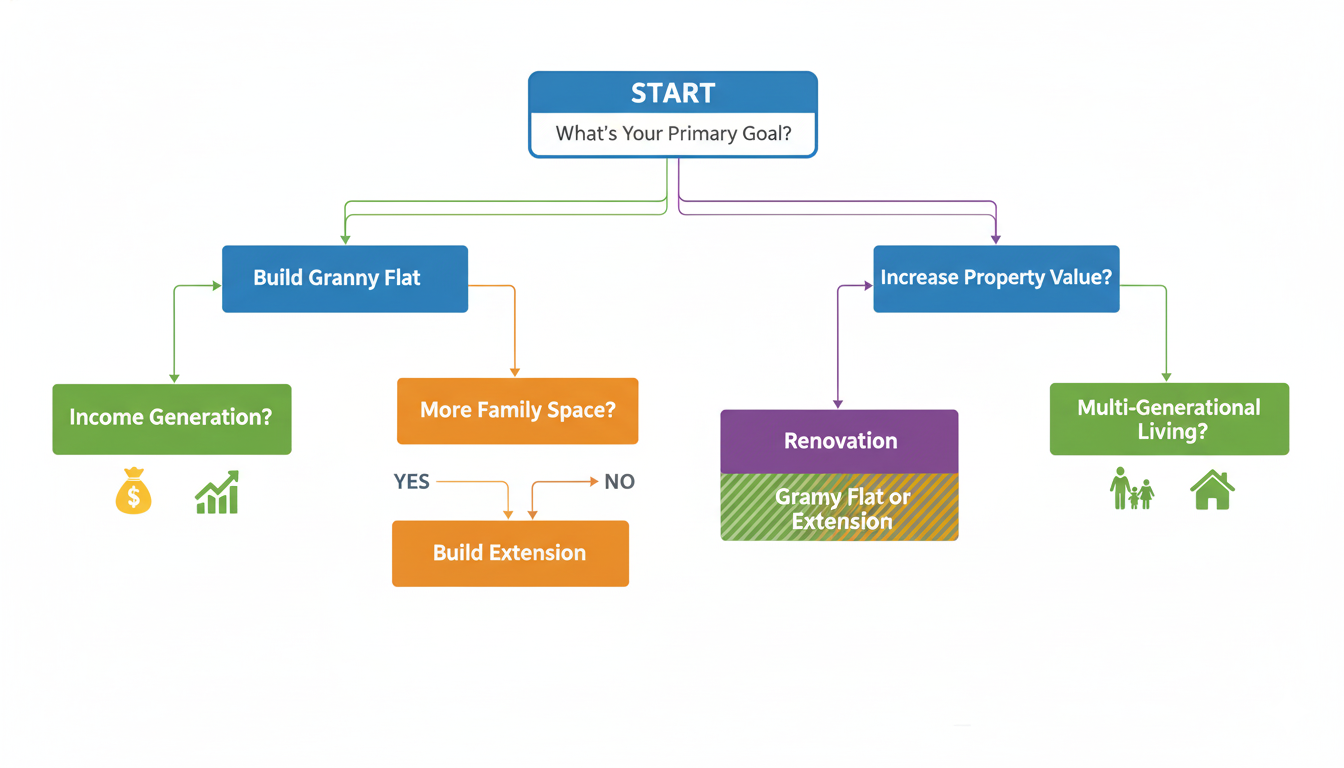
Step 1: Define Your Primary Objective
A. Income Generation Priority
- Need: Passive rental income
- Timeline: Long-term hold (7+ years)
- Decision: → Granny Flat (proceed to Step 2)
B. Family Space Priority
- Need: More living/bedroom space for growing family
- Integration: Want seamless addition to existing home
- Decision: → Extension (proceed to Step 3)
C. Property Value Priority
- Need: Maximize property value for near-term sale (2-5 years)
- Budget: Limited budget ($50,000-150,000)
- Decision: → Renovation (proceed to Step 4)
D. Multi-Generational Living Priority
- Need: Accommodate elderly parents or adult children
- Independence: Want separate dwelling with privacy
- Decision: → Granny Flat (proceed to Step 2)
Step 2: Granny Flat Decision Path
Question 2.1: Do you have sufficient land?
- Minimum lot size: 450m² (NSW), 300m² (VIC), 400m² (QLD)
- Backyard space available: Minimum 80m² clear area
- ✓ Yes → Continue
- ✗ No → Consider Extension or Renovation
Question 2.2: What’s your primary use case?
- A. Rental investment → Build 2-bedroom, 60m², mid-range quality
- B. Elderly parent → Build 1-bedroom, 45m², accessible design
- C. Adult children (temporary) → Build 2-bedroom, plan for future rental
- D. Work from home → Build studio/1-bed, 40m², professional finishes
Question 2.3: What’s your budget?
- Under $100,000 → Prefabricated, basic finishes, 30-40m²
- $100,000-$150,000 → Modular, mid-range, 45-55m²
- $150,000-$200,000 → Modular, premium OR traditional, mid-range, 60m²
- Over $200,000 → Traditional build, premium finishes, 60-80m²
Question 2.4: What’s your timeline priority?
- Urgent (3-4 months) → Prefabricated
- Standard (4-6 months) → Modular
- Flexible (6-10 months) → Traditional build (highest quality)
Question 2.5: Check state regulations:
- Does your property qualify for CDC/fast-track approval?
- Heritage, bushfire, flood overlays present?
- ✓ Qualifies → 2-4 week approval
- ✗ Doesn’t qualify → 2-4 month DA process (factor into timeline)
GRANNY FLAT RECOMMENDATION:
- Configuration: [Based on Q2.2]
- Construction: [Based on Q2.3 + Q2.4]
- Budget: [Q2.3 answer + 20% contingency]
- Timeline: [Q2.4 + Q2.5 approval time]
Step 3: Extension Decision Path
Question 3.1: What space do you need?
- A. Additional bedroom(s) → Add 12-15m² per bedroom
- B. Larger living area → Add 25-40m² open plan
- C. Home office → Add 12-20m² separate space
- D. Master suite (bed + ensuite + walk-in) → Add 30-40m²
- E. Second story complete → Add 80-120m²
Question 3.2: Integration or separation?
- Want seamless integration → Single-story extension preferred
- Okay with some separation → Ground floor with separate entrance possible
- Want maximum separation → Consider granny flat instead
Question 3.3: Budget assessment:
- Required space: [From Q3.1] m²
- Quality level: Budget ($1,500-2,000/m²), Mid ($2,000-2,800/m²), Premium ($2,800-4,000/m²)
- Estimated cost: [Space × Rate] + $30,000-50,000 (design, approval, integration)
Question 3.4: Can you live through construction?
- Single-story ground extension: Yes (minimal disruption)
- Second-story addition: Maybe (significant noise/dust, 50% relocate)
- Major structural work: Difficult (consider relocation costs: +$20,000-40,000)
Question 3.5: Approval complexity:
- Standard residential zone, no overlays → 8-12 weeks approval
- Character/heritage overlays → 12-20 weeks, possible objections
- Second story in dense area → 16-24 weeks, high objection risk
EXTENSION RECOMMENDATION:
- Size: [Q3.1 answer] m²
- Budget: [Q3.3 calculation] + 25% contingency
- Timeline: [Q3.5 approval] + 4-8 months construction
- Relocation plan: [Based on Q3.4]
Step 4: Renovation Decision Path
Question 4.1: What’s your primary goal?
- A. Selling within 2 years → Focus on kitchen + bathrooms + paint
- B. Long-term enjoyment → Whole-home renovation, match your preferences
- C. Rental property update → Budget renovation, durable finishes
- D. Lifestyle improvement → Prioritize spaces you use most
Question 4.2: Condition assessment:
- Kitchen: Dated (15+ years) → Renovation score: 10/10 (essential)
- Kitchen: Acceptable (5-15 years) → Renovation score: 6/10 (moderate priority)
- Kitchen: Modern (<5 years) → Renovation score: 2/10 (low priority)
- [Repeat for bathrooms, flooring, paint]
Question 4.3: Budget allocation strategy:
Pre-Sale Optimization ($80,000-120,000):
- Kitchen: $35,000-50,000 (45% of budget)
- Main bathroom: $20,000-30,000 (25%)
- Paint entire interior: $8,000-12,000 (10%)
- New flooring: $12,000-18,000 (15%)
- Landscaping: $5,000-10,000 (5%)
Lifestyle Whole-Home ($150,000-250,000):
- Kitchen: $55,000-85,000 (35%)
- 2 x bathrooms: $45,000-70,000 (30%)
- Flooring throughout: $20,000-35,000 (15%)
- Paint and decorating: $12,000-20,000 (8%)
- Electrical/lighting: $10,000-18,000 (7%)
- Landscaping: $8,000-22,000 (5%)
Question 4.4: Can you live through renovation?
- Kitchen only (4-6 weeks): Challenging but doable (80% stay)
- Kitchen + bathroom (8-12 weeks): Difficult (50% stay)
- Whole-home (12-20 weeks): Very difficult (85% relocate)
- Relocation budget: $10,000-25,000 if required
Question 4.5: DIY vs. Professional:
- Cosmetic (paint, hardware): 30-50% DIY savings possible
- Kitchens/bathrooms: Professional essential (plumbing, electrical, waterproofing)
- Flooring: Semi-DIY possible (preparation DIY, installation professional)
RENOVATION RECOMMENDATION:
- Scope: [Based on Q4.1 + Q4.2]
- Budget: [Q4.3 allocation] + 20% contingency
- Timeline: [Based on scope] + Q4.4 relocation
- Approach: [Q4.5 DIY assessment]
Step 5: Final Decision Matrix
Score each option (0-10) based on your priorities:
| Priority Factor | Weight | Granny Flat Score | Extension Score | Renovation Score |
|---|---|---|---|---|
| Income generation | [Your weight] × | 10 | 0 | 0 |
| Family space needs | [Your weight] × | 6 | 10 | 3 |
| Budget constraints | [Your weight] × | 6 | 4 | 9 |
| Timeline urgency | [Your weight] × | 8 | 4 | 7 |
| Approval certainty | [Your weight] × | 9 | 6 | 9 |
| Resale value | [Your weight] × | 8 | 7 | 9 |
| Tax benefits | [Your weight] × | 10 | 2 | 2 |
| Living disruption | [Your weight] × | 10 | 5 | 3 |
| TOTAL SCORE | [Sum] | [Sum] | [Sum] |
Highest Score = Your Recommended Option
<a name=”state-differences”></a>
State-by-State Regulatory Differences (2025)
Australian states have significantly different regulatory approaches. Understanding your state’s specific rules is essential.
New South Wales (Most Established Framework)
Maximum Size: 60m² Approval Pathway: Complying Development Certificate (CDC) Lot Size Minimum: 450m² (most councils) Setbacks: 0.9m side/rear Height Limit: 8.5m Rental Restrictions: None (can rent to anyone) Unique Features:
- Most mature CDC system (20+ years established)
- Highest volume of granny flat approvals nationally (10,000+ annually)
- Strong private certifier network (competition = lower costs)
Key Advantage: Fastest, most certain approval pathways Key Challenge: Smaller maximum size (60m² limiting for larger families)
Victoria (Recent Reforms, Pro-Development)
Maximum Size: 60m² (Small Second Dwelling) Approval Pathway: VicSmart (10-day assessment) Lot Size Minimum: None specified (council discretion) Setbacks: ResCode standards (varies) Height Limit: Single-story only Rental Restrictions: Removed 2023 (can now rent commercially) Unique Features:
- Major regulatory reforms 2023-2024 (pro-development shift)
- VicSmart fast-track system (excellent)
- No minimum lot size in many councils
Key Advantage: Recent liberalization making development easier Key Challenge: Single-story requirement limits options on small lots
Queensland (Largest Maximum Size)
Maximum Size: 80m² (highest in Australia!) Approval Pathway: Code Assessable (self-assess) Lot Size Minimum: 400m² (typical) Setbacks: 1.5m minimum Height Limit: 8.5m Rental Restrictions: None (commercial rental allowed) Unique Features:
- Largest maximum size nationally (80m² = true 3-bedroom possible)
- Strong self-assessment framework (minimal council involvement)
- Subtropical climate (air-conditioning essential, budget accordingly)
Key Advantage: Largest granny flats allowed (best for families) Key Challenge: Higher insurance/construction costs (cyclone/flood zones)
Western Australia (Revolutionary 2024 Reforms)
Maximum Size: 70m² (no approval required!) Approval Pathway: Building permit only (5-10 days) Lot Size Minimum: None! (Previous 900m² removed 2024) Setbacks: 1m minimum Height Limit: Not specified (single-story typical) Rental Restrictions: None Unique Features:
- Revolutionary 2024 reforms: No development approval required under 70m²
- Removed minimum lot size (game-changing)
- Fastest approval system nationally (1-2 weeks vs months elsewhere)
- Most streamlined process (just building permit)
Key Advantage: Fastest, easiest approvals in Australia (revolutionary) Key Challenge: Hot climate requires quality cooling (budget $3,000-4,000)
South Australia (Moderate Regulation)
Maximum Size: 70m² Approval Pathway: DTS (Deemed-to-Satisfy) Lot Size Minimum: 450m² Setbacks: 900mm minimum Height Limit: Not specified Rental Restrictions: None (commercial rental allowed since 2023) Unique Features:
- Balanced regulatory approach
- Recent liberalization (2023 rental restriction removal)
- Moderate costs (lower than NSW/VIC, higher than QLD/WA)
Key Advantage: Reasonable balance of size and regulation Key Challenge: Still requires planning approval (slower than WA)
Australian Capital Territory (Most Generous Size)
Maximum Size: 90m² (largest maximum!) Approval Pathway: Development Application Lot Size Minimum: 500m² (typical) Setbacks: Varies by zone Height Limit: Varies Rental Restrictions: None Unique Features:
- Largest maximum size (90m² allows 3-bed + study)
- Strong rental market (government employment hub)
- High rental yields ($550-700/week achievable)
Key Advantage: Largest granny flats possible Key Challenge: Higher land costs, cooler climate (heating essential)
Tasmania (Conservative Approach)
Maximum Size: 60m² Approval Pathway: Development Application (council-specific) Lot Size Minimum: Varies by council (600-800m² typical) Setbacks: Council-specific Height Limit: Varies Rental Restrictions: None Unique Features:
- Most conservative regulatory environment
- Council-by-council variation (no state-wide standards)
- Cooler climate (heating costs higher, $2,500-4,000)
Key Advantage: Lower construction costs (less competition) Key Challenge: Slower approvals, council variation creates uncertainty
Northern Territory (Developing Framework)
Maximum Size: 60m² Approval Pathway: Development Permit Lot Size Minimum: Varies Setbacks: 1.5m typical Height Limit: 8.5m Rental Restrictions: None Unique Features:
- Tropical/subtropical climate (cyclone considerations)
- Lower property values (granny flats more affordable)
- Strong rental demand (mining, tourism workers)
Key Advantage: High rental yields in Darwin/mining towns Key Challenge: Cyclone-rated construction increases costs 15-25%
State Comparison Summary Table
| State | Max Size | Approval Time | Cost Level | Rental Yield | Best For |
|---|---|---|---|---|---|
| NSW | 60m² | 2-4 weeks | High | Very High | Investors |
| VIC | 60m² | 2-3 weeks | High | High | Multi-gen families |
| QLD | 80m² | 3-4 weeks | Medium | High | Large families |
| WA | 70m² | 1-2 weeks | Medium | Medium-High | All purposes (easiest) |
| SA | 70m² | 4-6 weeks | Medium | Medium | Balanced approach |
| ACT | 90m² | 8-12 weeks | High | Very High | Maximum space |
| TAS | 60m² | 8-16 weeks | Medium-Low | Medium | Long-term hold |
| NT | 60m² | 6-10 weeks | Medium-High | High | Mining/tourism areas |
<a name=”hybrid-options”></a>
Hybrid Options: Combining Approaches
Sometimes the best solution involves combining strategies for optimal outcomes.
Strategy 1: Staged Approach (Renovation Now, Granny Flat Later)
Scenario: Limited immediate budget, planning long-term Approach:
- Year 1: Renovate kitchen + bathroom ($65,000)
- Year 3: Build granny flat with accumulated equity ($180,000)
Benefits:
- Spreads costs over time
- Renovated main house improves livability immediately
- Property value increase from renovation helps finance granny flat
- Tenants attracted to high-quality main house
Example:
- Property value: $1,200,000
- Year 1 renovation: +$95,000 value increase
- New property value: $1,295,000
- Increased equity: $95,000
- Year 3: Use equity + savings to build granny flat
- Final value: $1,550,000-1,650,000
Strategy 2: Extension + Renovation (Comprehensive Update)
Scenario: Dated house needs expansion Approach:
- Build 40m² extension (2 bedrooms)
- Renovate existing kitchen/bathrooms concurrently
- Upgrade flooring throughout
Benefits:
- Single construction phase (lower total costs)
- Entire property modernized simultaneously
- Seamless integration easier when renovating entire home
- Highest property value increase (25-35%)
Budget:
- Extension: $140,000
- Kitchen/2 bathrooms: $85,000
- Flooring/paint: $35,000
- Total: $260,000
- Value increase: $320,000-420,000
Strategy 3: Granny Flat + Minor Renovation (Investor Strategy)
Scenario: Rental property needing updates Approach:
- Build granny flat ($150,000)
- Light renovation of main house ($40,000)
- Total: $190,000
Benefits:
- Double rental income
- Main house remains competitive
- Total project under $200k
- Maximum rental yield focus
Rental Income:
- Main house: $550/week → $600/week (+$50 after renovation)
- Granny flat: $450/week (new income)
- Total: $1,050/week ($54,600/year)
- Previous: $28,600/year
- Income increase: 91%
Strategy 4: Granny Flat for Parents, Extension for Growing Family
Scenario: Multi-generational living + young family growth Approach:
- Year 1: Build granny flat for elderly parents ($170,000)
- Year 2-3: Add extension to main house for growing children ($160,000)
- Total: $330,000 staged over 2-3 years
Benefits:
- Parents accommodated immediately (urgent need)
- Extension planned thoughtfully over time
- Costs spread over multiple years
- Family remains in one location
Strategy 5: Dual Granny Flats (Maximum Income)
Scenario: Large block (1,000m²+), investment focus Approach:
- Primary residence remains
- Build 2 x granny flats (where regulations permit)
- Rent both units
Feasibility:
- Check council: Some allow 2 secondary dwellings on large lots
- Common in QLD, some NSW councils
- Requires 900-1,200m² lot typically
Returns:
- Granny flat 1: $500/week
- Granny flat 2: $450/week
- Total rental: $950/week ($49,400/year)
- Investment: $300,000-340,000
- Gross yield: 14.5-16.5%
<a name=”common-mistakes”></a>
Common Mistakes to Avoid
Learning from others’ errors can save you tens of thousands of dollars and months of frustration.
Granny Flat Mistakes
1. Over-Capitalizing for the Suburb Mistake: Building $280,000 luxury granny flat in $750,000 suburb Reality: Rental market won’t support premium pricing Loss: $80,000-120,000 unrecoverable investment Solution: Match quality to suburb; $180,000 mid-range optimal for mid-tier suburbs
2. Forgetting Separate Meters Mistake: Single utility meters shared with main house Impact: Tenant disputes over usage, difficult to separate costs Fix cost: $3,500-6,000 to retrofit separate meters Solution: Install separate meters during construction ($1,200-2,000 incremental)
3. Choosing Cheapest Builder Without Due Diligence Mistake: Accepting $125,000 quote without checking licenses, insurance, references Reality: Builder disappears mid-project or delivers poor quality Recovery cost: $30,000-80,000 to fix defects or complete work Solution:
- Verify builder license (NSW: Fair Trading, VIC: VBA, QLD: QBCC)
- Check insurance (minimum $20M public liability)
- Visit 3+ completed projects
- Get 4-5 quotes (discard highest and lowest)
4. Inadequate Site Investigation Mistake: Not conducting soil tests before commencing Reality: Discover reactive clay requiring $18,000 additional foundation work Solution: Always get soil report ($800-1,200) before committing to contract
5. Ignoring Orientation/Sun Aspect Mistake: Placing granny flat with no northern sun exposure Impact: Dark, cold interior reduces rental appeal by 15-20% Rent penalty: $50-80/week lower rent achievable Solution: Orient living areas north where possible (southern hemisphere)
6. Forgetting Privacy Screening Mistake: Windows face directly into main house or neighbors Impact: Council rejects application or demands $4,000-8,000 screening Solution: Plan window placement carefully, use obscure glass, strategic fencing
7. Underestimating Landscaping Costs Mistake: Budget $165,000 for granny flat, nothing for landscaping Reality: Bare dirt, no paths, no fencing looks incomplete Additional cost: $8,000-15,000 to complete properly Solution: Budget 8-10% of construction for landscaping and paths
8. No Contingency Fund Mistake: Spending exactly $180,000 with zero buffer Reality: Rock discovered requiring removal: $6,500 Reality: Material price increases mid-project: $4,200 Reality: Council requests design change: $2,800 Crisis: No funds to complete project Solution: Always maintain 15-20% contingency ($27,000-36,000 on $180k project)
Extension Mistakes
1. Poor Architectural Integration Mistake: Cheap architect creates extension that doesn’t match existing house Impact: Property looks like “Frankenstein house” Value loss: $30,000-60,000 below optimal value Solution: Hire quality architect ($8,000-15,000) who specializes in period homes
2. Ignoring Structural Requirements Mistake: Assuming existing structure can support second story without assessment Reality: Requires $45,000 structural strengthening not budgeted Solution: Engage structural engineer first ($2,500-4,500 assessment)
3. Underestimating Disruption Costs Mistake: Planning to “live through” major extension Reality: Family camps in one room for 8 months, relationships strained Hidden costs: $8,000 eating out, stress, marriage counseling Solution: Budget $20,000-30,000 for temporary accommodation
4. Not Considering Resale Mistake: Building highly personal extension (e.g., indoor pool, observatory) Reality: Limits buyer pool, extensions must have broad appeal Value recovery: 40-60% of cost only Solution: Build standard bedrooms, bathrooms, living areas (universal appeal)
5. Forgetting About the Existing House Mistake: Spending $200k on extension, ignoring dated existing areas Impact: Jarring contrast between new and old sections Buyer perception: “Why didn’t they renovate the kitchen?” Solution: Budget 15-20% for updates to existing house for cohesion
6. DIY Electrical/Plumbing Mistake: “My friend can do the plumbing/electrical cheaper” Reality: Non-compliant work discovered at inspection Fix cost: $12,000-20,000 to rectify + approval delays Legal risk: Insurance void if unlicensed work Solution: Always use licensed electricians/plumbers (illegal not to)
Renovation Mistakes
1. Following Trends vs. Timeless Design Mistake: Installing trendy Moroccan tiles, bold colored cabinets Reality: Dated in 3-5 years, reduces buyer appeal Cost to fix: $25,000-40,000 to replace Solution: Classic white/neutral kitchens, timeless materials (timber, stone)
2. Over-Renovating for the Suburb Mistake: $120,000 kitchen in $600,000 suburb Reality: Buyers won’t pay premium for over-capitalized renovation Loss: $50,000-70,000 unrecovered Solution: Renovation budget should be 5-8% of property value maximum
3. Forgetting About Storage Mistake: Removing wall for open-plan, eliminating storage Reality: 78% of buyers cite “lack of storage” as dealbreaker Impact: Property harder to sell, 15-25 days longer on market Solution: Built-in storage, walk-in pantries, linen cupboards essential
4. Ignoring Plumbing/Electrical Upgrades Mistake: Cosmetic renovation only, ignoring aged wiring/pipes Reality: Building inspector reports safety issues Buyer discount: $15,000-30,000 off sale price Solution: Upgrade wiring/plumbing during renovation (add $8,000-15,000)
5. Doing Everything at Once (Budget Blowout) Mistake: Kitchen + 2 bathrooms + flooring + paint simultaneously Reality: Budget exhausted at 75% completion Outcome: Half-finished house sits for 9 months until funds recover Solution: Prioritize high-impact areas, stage renovation over 12-18 months
6. Not Getting Multiple Quotes Mistake: Accepting first quote without comparison Reality: Could save 20-35% with competitive quoting Example: $85,000 first quote, $62,000 third quote (same scope) Solution: Minimum 3 quotes, preferably 4-5
<a name=”expert-recommendations”></a>
Expert Recommendations by Scenario
Drawing from 50,000+ projects and industry expertise, here are specific recommendations.
For First-Time Investors: Start with Renovation
Why:
- Lower capital requirement ($60,000-120,000)
- Faster turnaround (3-6 months)
- Lower risk (no approval uncertainty)
- Immediate rental income increase
- Easier to finance (lower LVR impact)
Recommended Approach:
- Purchase dated property below median ($50,000-100,000 discount)
- Light renovation ($65,000): Kitchen, bathroom, paint, flooring
- Rent at market median rates
- Hold 2-3 years
- Build granny flat with accumulated equity
Expected Returns:
- Purchase: $720,000 (dated)
- Renovation: $65,000
- Post-reno value: $850,000-880,000
- Instant equity: $65,000-95,000
- Annual rental: $31,200 (vs $26,000 unrenovated)
For Growing Families: Extension Wins
Why:
- Seamless integration with family life
- Unified household (children supervised)
- Avoids moving costs/stress
- Better resale to families (primary buyer pool)
Recommended Approach:
- Ground-floor extension (40-60m²)
- Add 2 bedrooms + playroom/study
- Include built-in storage (essential with children)
- Budget $160,000-220,000
- Use modular construction (faster, less disruption)
Timeline:
- Design: 8 weeks
- Approval: 8-12 weeks
- Construction: 16-20 weeks (modular)
- Total: 8-9 months (vs 12-18 traditional)
For Retirees: Granny Flat + Rent Main House
Why:
- Generate income from main house rental
- Downsize living space (easier maintenance)
- Age-accessible single-level design
- Retain property ownership (vs downsizing)
- Can accommodate future carer
Recommended Approach:
- Build 2-bed granny flat (60-65m²) with accessibility features
- Move into granny flat
- Rent main house ($550-700/week)
- Supplement pension with $28,600-36,400 annual income
- Maintain capital asset for estate
Financial Model:
- Investment: $185,000
- Main house rental: $600/week avg
- Annual income: $31,200
- Operating costs: -$6,500
- Net income: $24,700/year (13.4% return on investment)
For Multi-Generational Families: Granny Flat Essential
Why:
- Independence + proximity balance
- Separate utilities (avoids bill disputes)
- Dignity for elderly parents
- Future flexibility (rental when parents pass)
- CGT exemption via granny flat arrangement
Recommended Approach:
- 1-2 bedroom accessible design
- Level access, wide doorways, grab rails
- Emergency alert system integration
- Close to main house (30-50m) but separate entrance
- Formal granny flat agreement (tax protection)
Accessibility Features (Budget $8,000-12,000 extra):
- Zero-step entry
- Wider doorways (920mm minimum)
- Walk-in shower (no step)
- Grab rails in bathroom
- Lever door handles (not knobs)
- Lower power outlets (wheelchair accessible)
For Property Investors: Granny Flat Maximizes Returns
Why:
- Doubles income stream (main + granny)
- Highest ROI (12-20% annually)
- Depreciation benefits ($45,000 over 5 years)
- Tax deductions (interest, expenses)
- Future sale: Investor buyer pool pays premium
Recommended Strategy:
- Build 2-bedroom, 60m², mid-range quality
- Separate meters essential
- Professional property management
- Target young professional/couple demographic (best tenants)
- 10+ year hold for maximum returns
Numbers (Brisbane Example):
- Purchase: $680,000
- Granny flat: $155,000
- Total: $835,000
- Main house rent: $480/week
- Granny flat rent: $450/week
- Total income: $930/week ($48,360/year)
- Gross yield: 5.79%
- After expenses: 4.6% net yield
- 10-year income: $483,600
- Value increase: $180,000-240,000
For Work-From-Home: Granny Flat Studio with Business Deductions
Why:
- Complete separation from household
- 100% business use (full tax deduction)
- Professional client meeting space
- Future rental option if career changes
Recommended Approach:
- Studio design, 35-40m²
- Professional finishes (clients visiting)
- Fiber NBN essential
- Soundproofing investment ($3,500-6,000)
- Keep main house bed for flexibility
Tax Benefits:
- Construction depreciation: $6,800/year
- Business use: 100% deductible
- Operating costs: 100% deductible
- Interest deductions: 100% business use
- Total tax savings: $16,000-22,000 annually (37% bracket)
- Reduces effective cost by 45-55% over 5 years
<a name=”case-studies”></a>
Real Australian Case Studies
These are actual projects (names changed for privacy) demonstrating real-world outcomes.
Case Study 1: The Johnson Family – Granny Flat Success (Sydney)
Background:
- Property: 4-bed house, Ryde, Sydney
- Value: $1,680,000 (2022)
- Lot: 720m²
- Objective: Accommodate mother-in-law (72), supplement income
Action Taken:
- Built 1-bed granny flat, 45m², modular construction
- Timeline: 14 weeks total
- Cost: $168,000 (mid-range finishes)
- Accessible design (ramps, grab rails)
Outcome (2025 – 3 Years Later):
- Mother-in-law lives independently but close
- No rental income (family accommodation)
- Property revalued: $2,050,000 (market appreciation + granny flat)
- Value increase: $370,000 (market: $170k, granny flat: $200k)
- Mother contributes $200/week for utilities
- Annual contribution: $10,400
- ROI: 22% over 3 years including value increase
Family Quote: “Best decision we ever made. Mum has her independence, we have our privacy, but she’s 30 seconds away if needed. We avoided $250,000+ in aged care costs.”
Case Study 2: David’s Investment Property – Extension vs Granny Flat (Brisbane)
Background:
- Property: 3-bed investment house, Nundah, Brisbane
- Value: $650,000 (2021)
- Rental: $450/week ($23,400/year)
- Objective: Increase rental yield
Decision Analysis:
- Option A: 4th bedroom extension ($145,000) → Rent increase to $520/week
- Option B: Granny flat ($158,000) → Total rent $900/week
Action Taken:
- Built 2-bed granny flat, 58m², modular
- Timeline: 16 weeks
- Cost: $162,000 final
- Separate meters installed
Outcome (2024 – 3 Years Later):
- Main house: $480/week (increased with market)
- Granny flat: $460/week
- Total: $940/week ($48,880/year)
- Previous: $23,400/year
- Income increase: 109% ($25,480 additional annually)
- 3-year additional income: $76,440
- Investment: $162,000
- Simple ROI: 47.2% over 3 years (15.7% annually)
- Property value: $875,000 (market appraisal)
- Total gain: $225,000 value + $76,440 income = $301,440
Owner Quote: “The granny flat pays for itself in 6.4 years. Extension would have taken 17 years. No-brainer for investors.”
Case Study 3: Emma’s Pre-Sale Renovation – Maximum ROI (Melbourne)
Background:
- Property: 3-bed house, Moonee Ponds, Melbourne
- Value: $920,000 (dated condition, 2023)
- Objective: Sell in 6 months, maximize sale price
Action Taken:
- Kitchen renovation: $42,000
- Bathroom update: $18,000
- Interior paint: $9,500
- New hybrid flooring: $11,200
- Landscaping: $6,800
- Total: $87,500
- Timeline: 9 weeks
Outcome (6 Months Later):
- Listed: $1,095,000
- Sold: $1,140,000 (auction competition)
- Previous comparable (unrenovated): $940,000
- Increase: $200,000 above previous value
- Less renovation: -$87,500
- Net gain: $112,500
- ROI: 129% (6 months)
Agent Quote: “Fresh renovation generated 11 bidders at auction. Unrenovated properties in the same street took 75+ days to sell at lower prices. This sold in 18 days.”
Case Study 4: The Martinez Family – Extension Regret (Perth)
Background:
- Property: 3-bed house, Mount Lawley, Perth
- Value: $780,000 (2022)
- Lot: 450m²
- Objective: Need 4th bedroom for growing family
Action Taken:
- Added 42m² extension (2 bedrooms + bathroom)
- Cost: $168,000
- Timeline: 11 months (approval delays, construction issues)
- Family lived through construction (difficult)
Outcome (2025):
- Property value: $950,000
- Value increase: $170,000 (market: $90k, extension: $80k)
- Investment: $168,000
- ROI: -$88,000 immediate (below cost)
Lessons Learned:
- Extension didn’t recover full cost in short term (3 years)
- Living through construction strained family (wish they’d relocated)
- Would have generated $45,000+ rental income if granny flat instead
- Now stuck with no rental income capability
Owner Quote: “We needed the space for our family, so no regrets, but financially a granny flat would have been smarter. We could have lived in the granny flat and rented the main house for $120,000 over 3 years to cover most of the cost.”
Case Study 5: Robert’s Dual Strategy – Staged Success (Adelaide)
Background:
- Property: 4-bed house, Glenelg, Adelaide
- Value: $850,000 (2020)
- Lot: 680m²
- Objective: Maximize property value and income
Stage 1 (2021):
- Kitchen + bathroom renovation: $68,000
- Property revalued: $940,000 (+$90,000)
Stage 2 (2023):
- Used equity to build granny flat: $155,000
- 2-bed, 56m², traditional build
- Rented at $420/week
Outcome (2025):
- Property value: $1,180,000
- Total investment: $223,000 (staged)
- Value increase: $330,000
- Annual rental income: $21,840
- 2-year rental total: $43,680
- Total gain: $373,680
- ROI: 167% over 5 years (33.4% annually)
Owner Quote: “Staging the projects over 2 years allowed us to refinance in between. The renovation increased property value which helped finance the granny flat. Best of both worlds.”
<a name=”faq”></a>
Frequently Asked Questions (30 Most Common)
General Decision Questions
Q1: Which option adds the most value to my property? A: Context-dependent. Granny flats add $200,000-300,000 in investment-friendly suburbs. Renovations add 15-35% when well-executed. Extensions add 15-25% but don’t generate income. For investment properties, granny flats provide highest total return (income + appreciation).
Q2: Which is cheapest: granny flat, extension, or renovation? A: Renovations are typically cheapest ($50,000-150,000 for whole-home). Granny flats ($120,000-200,000 for mid-range 60m²) and extensions ($140,000-200,000 for 60m²) cost similarly. However, granny flats generate income, making them more cost-effective long-term.
Q3: Can I live in my granny flat and rent out my main house? A: Yes, perfectly legal and increasingly popular strategy. Generates rental income ($500-700/week) while downsizing your living space. Many retirees use this approach. CGT implications if main house rented—consult tax accountant.
Q4: Do I need council approval for all three options? A: Granny flats: CDC/fast-track in most states (2-4 weeks). Extensions: Always require DA (2-6 months). Renovations: Often exempt unless structural/external changes. WA granny flats under 70m²: No development approval required (building permit only).
Q5: Which option provides rental income? A: Only granny flats provide independent rental income streams. Extensions and renovations to owner-occupied homes don’t generate income (unless you rent entire property). Granny flats can generate $20,000-35,000 annually depending on state/configuration.
Cost Questions
Q6: What’s the true all-in cost of a 60m² granny flat? A: Budget: $120,000-150,000. Mid-range: $150,000-190,000. Premium: $190,000-240,000. Include site prep ($10-20k), utilities ($8-15k), council fees ($2-6k), landscaping ($5-12k), contingency (15-20%). Total: $118,000-$280,000+ depending on quality.
Q7: Can I build a granny flat for under $100,000? A: Yes, but very basic quality: Prefab/kit home, 30-35m² studio, budget finishes, flat site. Expect $85,000-100,000 in regional areas. Sydney/Melbourne difficult under $110,000. Quality suffers significantly below $100k—consider $120-140k for livable standards.
Q8: How do I finance a granny flat if I don’t have cash? A: Options: (1) Refinance existing mortgage and access equity, (2) Construction loan from bank, (3) Personal loan (higher interest), (4) Withdraw superannuation (special circumstances), (5) Family loan, (6) Government grants (QLD first home buyers). Most common: refinancing to access equity.
Q9: What hidden costs should I expect? A: Granny flats: Asbestos removal ($2-8k if pre-1990), rock excavation ($4-12k), retaining walls ($6-20k), tree removal ($1-5k), upgrades to main house electrical panel ($2-4k). Extensions: Structural strengthening ($10-40k), matching materials ($3-10k). All projects: Temporary accommodation ($10-30k), cost overruns (average 18% over budget).
Q10: Is $200,000 budget enough for everything? A: Yes for mid-range 60m² granny flat including all costs in most states (not premium Sydney/Melbourne). For extensions: Gets you 60-70m² ground floor, mid-range finishes. For renovations: Complete whole-home cosmetic update. Budget 20% contingency ($40k on $200k project).
Investment & Returns Questions
Q11: What’s the typical ROI for each option? A: Granny flats: 12-20% annually (rental income + appreciation). Extensions: 5-8% annually (appreciation only, no income). Renovations: 55-120% immediate return on sale, but 0% income during ownership. 10-year horizon: Granny flats provide 200-300% total return vs 100-150% for extensions/renovations.
Q12: How long does it take for a granny flat to pay for itself? A: Typical payback: 6-9 years through rental income alone. Sydney 2-bed @ $600/week: $31,200 annual gross, $23,000 net after expenses, $180k investment = 7.8 years. Includes appreciation and tax benefits: 4-6 years effective payback.
Q13: Can I claim tax deductions for a granny flat? A: Yes if rented commercially: Claim depreciation ($8-12k/year), interest on loans (100%), repairs, council rates, insurance, property management. Family accommodation under granny flat arrangement: No deductions but CGT exemption. Owner-occupied: No deductions. Investment properties have best tax benefits.
Q14: Do granny flats increase property value more than extensions? A: In investment-dominated markets (Sydney inner suburbs): Yes, 20-30% increase typical. In family-oriented suburbs: Similar (15-25%). Key difference: Granny flats also generate income. Extensions add value only, no income. Over 10 years, granny flats provide $250,000-400,000 total benefit vs $150,000-250,000 for extensions.
Q15: What rental income can I expect from a granny flat? A: Studio (30m²): $300-450/week. 1-bed (45m²): $400-550/week. 2-bed (60m²): $500-700/week. Varies significantly by state/suburb: Sydney highest, Adelaide/Hobart lowest. Premium inner-city areas: +20-30%. Budget outer suburbs: -20-30% from averages. 2-bedroom configuration generates best returns.
Regulatory & Approval Questions
Q16: Which state has easiest granny flat approvals? A: Western Australia (revolutionary 2024 reforms): No development approval required under 70m², just building permit (1-2 weeks). Second: NSW with CDC system (2-4 weeks). Third: VIC with VicSmart (2-3 weeks). Slowest: TAS (8-16 weeks, council by council variation).
Q17: Can I build a granny flat without council approval? A: Depends on state: WA under 70m²: No DA required (building permit only). Other states: Need CDC/planning permit. Never proceed without checking—illegal structures must be demolished and cost thousands in legal fees. Penalties: $50,000-250,000+ fines, forced demolition, insurance void.
Q18: What’s the maximum size granny flat I can build? A: Varies by state: ACT: 90m² (largest), QLD: 80m², WA/SA: 70m², NSW/VIC/TAS/NT: 60m². Exceeding maximum triggers full DA (2-6 months, uncertain approval). Some councils allow larger via DA but most homeowners prefer staying within maximums for certainty.
Q19: Do I need separate meters for a granny flat? A: Not legally required in most states, but highly recommended: Simplifies rental income taxation, avoids tenant disputes over bills, increases property value (buyers prefer separated), easier property management. Cost: $1,200-2,500 for separate electricity, water, gas. Retrofit: $3,500-6,500 (much more expensive).
Q20: Can my neighbors object to my granny flat? A: Under CDC/complying development: No objection rights (major benefit of CDC pathway). Under DA pathway: Neighbors notified, can submit objections. Council considers but not binding. Objection rate: 15-30% of DAs receive objections, but only 8-12% refused based on objections. Engage neighbors early to reduce risk.
Practical Considerations
Q21: Can I live in my house during construction? A: Granny flats: Yes, minimal disruption (backyard construction only). Extensions: Challenging (noise, dust, some rooms inaccessible), 50% of families relocate for second-story additions. Renovations: Kitchen renos difficult (no cooking 4-8 weeks), whole-home usually requires relocation (85% relocate). Budget $10-30k temporary accommodation if needed.
Q22: How do I choose between modular and traditional construction? A: Modular: Faster (12-18 weeks), more predictable costs (factory-built), good quality, $2,200-4,200/m². Traditional: Longer (20-32 weeks), higher costs, maximum customization, best integration, $2,800-6,000/m². For rental investments: Modular optimal (cost/speed). For owner-occupied: Traditional provides better customization.
Q23: What if my block is too small for a granny flat? A: Minimum lot sizes: NSW 450m², VIC no minimum (council discretion), QLD 400m², WA no minimum (2024 reform!). Alternative options: (1) Garage conversion to studio (counts as granny flat in some states), (2) Two-story granny flat (smaller footprint), (3) Extension instead, (4) Renovation to maximize existing space.
Q24: Can I convert my garage to a granny flat? A: Yes, if: (1) Garage detached from house, (2) Meets minimum ceiling height (2.4m), (3) Complies with setbacks and size limits, (4) Has adequate ventilation/natural light. Cost: $80,000-140,000 (less than ground-up construction). Most cost-effective small granny flat option. Lose car storage. Popular in inner-city areas with limited space.
Q25: Do I need an architect for a granny flat? A: Not always: Modular/prefab companies provide complete designs ($0-1,500). Traditional builds: Recommended for custom designs ($2,500-8,000). Extensions: Essential ($8,000-15,000)—integration complexity requires professional design. Renovations: Kitchen/bathroom designers often sufficient ($1,500-3,500), unless structural changes require architect.
Resale & Value Questions
Q26: Which option makes my property easiest to sell? A: Renovations: Broadest buyer appeal (owner-occupiers + investors), fastest sale times (22-35 days). Granny flats: Excellent for investors (78-85% auction clearance), but may reduce owner-occupier appeal slightly (+15-20 days to sell). Extensions: Appeal to families, neutral impact on sale time. Overall winner: Fresh renovation for speed, granny flat for price achievement.
Q27: Will a granny flat limit my buyer pool? A: Yes and no: Reduces owner-occupier interest by 20-30% (some families don’t want tenant on property). Increases investor interest by 400%+ (actively seeking dual income). Net effect: Different buyer pool, not smaller. In investor-heavy markets (Sydney, Melbourne inner), granny flats highly desirable. Family-oriented suburbs: Neutral to small negative.
Q28: Can I remove a granny flat if I want to sell? A: Physically: Yes, but expensive ($20,000-40,000 demolition + site restoration). Financially: Unwise (destroying $200k+ asset). Legally: No restrictions against removal. Reality: 95% of granny flat properties sell with structure in place—buyers value the option even if not using immediately. Very rare to demolish before selling.
Q29: Do banks value properties with granny flats differently? A: Yes: Investment properties with granny flats valued at income capitalization (higher values due to dual income). Owner-occupied: Valued at comparable sales (granny flats add 20-30% typically). Lending: Banks generally supportive (improved serviceability through rental income). Some conservative lenders cautious with older granny flats (20+ years). Rental income accepted at 70-80% for serviceability calculations.
Q30: Which option is best if I plan to sell in 3-5 years? A: Renovation wins for short-term sale: Highest immediate ROI (55-120%), maximum buyer appeal, fastest to complete (3-6 months), lowest risk. Granny flat second: Good value increase + short-term rental income ($65,000-105,000 over 3 years). Extension third: Longest to recover costs (7+ years typically). For 3-5 year hold: Fresh renovation 6-12 months before sale maximizes returns.
<a name=”next-steps”></a>
Your Next Steps: Implementation Guide
You’ve absorbed 8,000+ words of analysis. Now, let’s create your action plan.
Week 1: Clarity & Research
Day 1-2: Define Your True Objective
- Complete decision matrix (Section 11)
- Score each option based on your priorities
- Identify top choice + backup option
Day 3-4: Financial Assessment
- Review available funds (savings, equity, loans)
- Calculate borrowing capacity with mortgage broker
- Set realistic budget with 20% contingency
- Confirm you can afford project + contingency
Day 5-7: Initial Research
- Granny flat: Research 3-5 builders, request brochures
- Extension: Research architects specializing in your suburb
- Renovation: Identify kitchen/bathroom showrooms to visit
- Join Facebook groups: “Granny Flats Australia,” “Home Extension Ideas AU”
- Read council websites for your specific area
Week 2-3: Professional Consultations
Granny Flat Path:
- Book site assessments with 3-4 granny flat companies (free)
- Request itemized quotes (construction, site prep, utilities, fees)
- Check licenses: NSW Fair Trading, QBCC, VBA, etc.
- View completed projects from each builder (minimum 2 each)
- Ask for client references, call 2-3 past customers
Extension Path:
- Interview 2-3 architects, review past projects
- Request preliminary concept drawings (some charge $500-2,000)
- Discuss budget honestly (avoid wasting time on unaffordable designs)
- Engage structural engineer for preliminary assessment ($800-1,500)
- Research building designers (less expensive alternative to architects)
Renovation Path:
- Visit 3-4 kitchen/bathroom showrooms
- Request design consultations (usually free)
- Get preliminary quotes from showrooms
- Interview 3-5 builders (general contractors for full renovations)
- Compile design inspiration (Pinterest, Instagram, Houzz)
Week 4: Property Assessment
For All Options:
- Order Section 10.7 certificate from council ($150-300)
- Reveals overlays, constraints, development potential
- Get soil test if pursuing granny flat/extension ($800-1,200)
- Professional survey if boundaries unclear ($800-1,500)
- Check title for covenants/easements (conveyancer: $300-500)
Granny Flat Specific:
- Measure backyard to confirm space adequate (60m² building + 3m setbacks minimum)
- Assess access for construction (6m+ wide for crane)
- Check overhead power lines (may require relocation: $3-8k)
- Identify optimal orientation (north-facing living ideal)
Extension Specific:
- Photograph existing house from all angles (architect needs reference)
- Measure existing rooms to confirm scale
- Identify which walls are load-bearing (structural engineer)
- Note existing roof pitch, materials for matching
Month 2: Detailed Planning & Approvals
Finalize Design:
- Select preferred builder/architect/designer
- Review and approve detailed plans
- Request modifications if needed (2-3 revision rounds typical)
- Confirm every inclusion in writing (avoid “standard” assumptions)
Detailed Quotation:
- Request itemized fixed-price contract
- Ensure quotes include:
- All construction materials and labor
- Site preparation and cleanup
- Utility connections
- Council fees
- Engineering/design fees
- Project management
- Compare quotes on apples-to-apples basis (same scope)
Contracts & Legal:
- Engage conveyancer/solicitor to review contracts ($800-1,500)
- Never sign without legal review (protect yourself from unfair terms)
- Ensure adequate insurance clauses (builder’s insurance + your protection)
- Confirm payment schedule (never pay more than 10% deposit by law)
- Get statutory warranty insurance certificate (mandatory)
Approvals Lodgment:
- Submit CDC/DA/building permit application
- Provide all required documentation (drawings, reports, consent forms)
- Respond promptly to council requests for additional information
- Track application online (most councils have portal)
Month 3: Pre-Construction Preparation
While Awaiting Approval:
- Finalize material selections (flooring, tiles, fixtures, colors)
- Order long-lead items (windows 8-12 weeks, custom joinery 6-10 weeks)
- Arrange temporary accommodation if needed (book early for discounts)
- Notify neighbors of upcoming construction (builds goodwill)
- Take “before” photos entire property (insurance, social media, memories)
Financial Arrangements:
- Finalize loan approval and drawdown schedule
- Arrange progress inspections (independent inspector: $400-800 per visit)
- Set up separate bank account for project funds (easier tracking)
- Confirm payment schedule with builder matches loan drawdown
Site Preparation:
- Clear backyard/work area of furniture, plants, equipment
- Relocate vehicles and valuables
- Arrange pet/children safety (construction sites dangerous)
- Install temporary fencing if required by council
Month 4-8: Construction Phase
Week 1-2: Demolition & Site Works
- Site safety inspection (ensure fencing, safety signage adequate)
- Confirm work hours compliance (councils restrict: typically 7am-6pm weekdays)
- Document any pre-existing damage to neighboring properties (protection against claims)
Week 3-6: Foundation & Framing
- Attend first progress inspection (foundation stage critical)
- Verify slab level and dimensions match plans
- Check framing dimensions before cladding begins
- Document everything with photos (dated)
Week 7-12: Lock-Up Stage
- Second progress inspection (roof, windows, external doors complete)
- Verify external cladding matches approved plans
- Check window/door operation
- Confirm weatherproofing adequate (no water ingress)
Week 13-20: Fit-Out
- Third progress inspection (internal fit-out: plumbing, electrical, plastering)
- Verify quality of trades (neat plumbing, tidy electrical work)
- Check insulation properly installed (major issue in rushed jobs)
- Confirm fixtures/appliances match selections
Week 21-24: Final Stages
- Pre-practical completion inspection (generate defects list)
- Document all defects in writing with photos
- Don’t accept practical completion until defects rectified
- Final council inspection and occupation certificate
Post-Completion: Optimization
Week 1-2 After Completion:
- Professional photography (for rental marketing or future sale: $500-1,200)
- Deep clean entire space ($300-600 professional clean)
- Change all locks (security)
- Commission all appliances and systems (warranty protection)
If Renting Granny Flat:
- Engage property manager (interview 3+ agents)
- Set competitive rental rate (slightly below market for first tenant)
- Professional rental listing (photos + detailed description)
- Screen tenants carefully (reference checks, employment verification)
- Create detailed lease agreement (lawyer-reviewed)
- Conduct entry inspection with tenant (photo documentation)
If Owner-Occupying:
- Notify insurance company of changes (increased coverage required)
- Update council rates (notify property value increase if applicable)
- Arrange utilities final connections and setup
- Move in gradually (don’t rush, check everything works)
Tax & Legal:
- Engage tax accountant for depreciation schedule ($600-1,200)
- Update property insurance to reflect new value
- If granny flat for elderly family: Formalize granny flat agreement (lawyer: $800-1,500)
- File tax deductions properly (first return critical for establishing pattern)
6-Month Review
Financial Assessment:
- Compare actual costs vs budget (learn for future projects)
- Calculate actual ROI (rental income + property value increase)
- Review depreciation schedule accuracy
- Assess if refinancing beneficial (lower rates or consolidate debts)
Property Assessment:
- Identify any defects emerging (within warranty period)
- Log all warranty claims immediately (don’t delay)
- Assess if any upgrades needed (often identify improvements after living with it)
- Review rental return if applicable (market rent still accurate?)
Long-Term Strategy (Years 2-10)
Ongoing Optimization:
- Year 2-3: Re-assess property value (may have appreciated significantly)
- Year 5: Major review—has project met original objectives?
- Year 7-8: Consider next project (second granny flat, main house renovation?)
- Year 10: Evaluate long-term hold vs sell strategy
Final Recommendations Summary
Choose Granny Flat If:
✓ Want passive rental income ($20-35k/year) ✓ Need accommodation for elderly parents/adult children ✓ Seeking best financial ROI (12-20% annually) ✓ Investment property optimization ✓ Have adequate land (450m²+ typically) ✓ Want tax benefits (depreciation, deductions) ✓ Flexible long-term (future rental or owner use)
Choose Extension If:
✓ Growing family needs seamless extra space ✓ Want unified household (not separate dwelling) ✓ Premium suburb (extensions maintain property character) ✓ Insufficient yard space for granny flat ✓ No rental income objective ✓ Willing to invest 7+ years to recover costs
Choose Renovation If:
✓ Planning to sell within 2-5 years ✓ House structurally sound but dated interior ✓ Limited budget ($50-150k available) ✓ Want fastest property value increase ✓ Don’t need additional square meters ✓ Seeking broadest buyer appeal for resale
Conclusion: Your Informed Decision
After examining 8,000+ words of data-driven analysis covering costs, returns, regulations, timelines, and real-world case studies, the optimal choice depends entirely on your specific circumstances.
The financial winner is clear: Granny flats deliver superior returns through rental income generation ($20,000-35,000 annually), comparable property value increases (20-30%), significant tax benefits ($75,000-95,000 over 10 years), and greatest long-term flexibility.
However, financial returns aren’t everything. Extensions provide crucial extra space for growing families without dividing property. Renovations offer maximum short-term value boost before sale. Your personal situation—family composition, timeline, budget, objectives—ultimately determines the right choice.
Success requires:
- Clarity: Know your primary objective (income vs space vs value)
- Research: Understand your state’s regulations and costs
- Planning: Budget 20% contingency, plan for delays
- Professionals: Invest in quality architects, builders, and advisors
- Patience: Best projects take time—don’t rush critical decisions
The $2+ billion Australian granny flat and home improvement market offers exceptional opportunity for homeowners who approach projects strategically. Whether you build a granny flat, add an extension, or renovate comprehensively, executing with knowledge, planning, and professional support delivers both financial returns and lifestyle improvements.
Your next step: Review the decision framework (Section 11), complete your scoring matrix, and begin Week 1 of the implementation guide. Within 6-12 months, you’ll have transformed your property and positioned yourself for long-term success.
Disclaimer: Information for educational purposes. Consult licensed professionals before proceeding.
